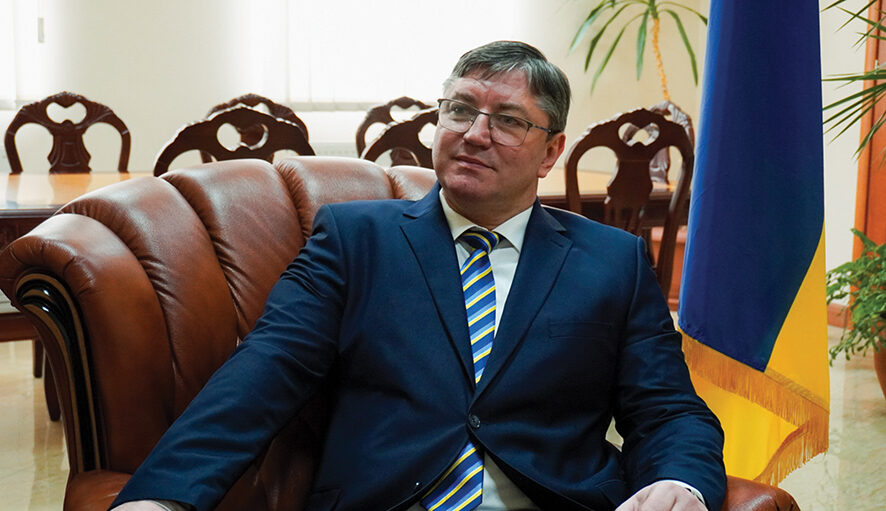
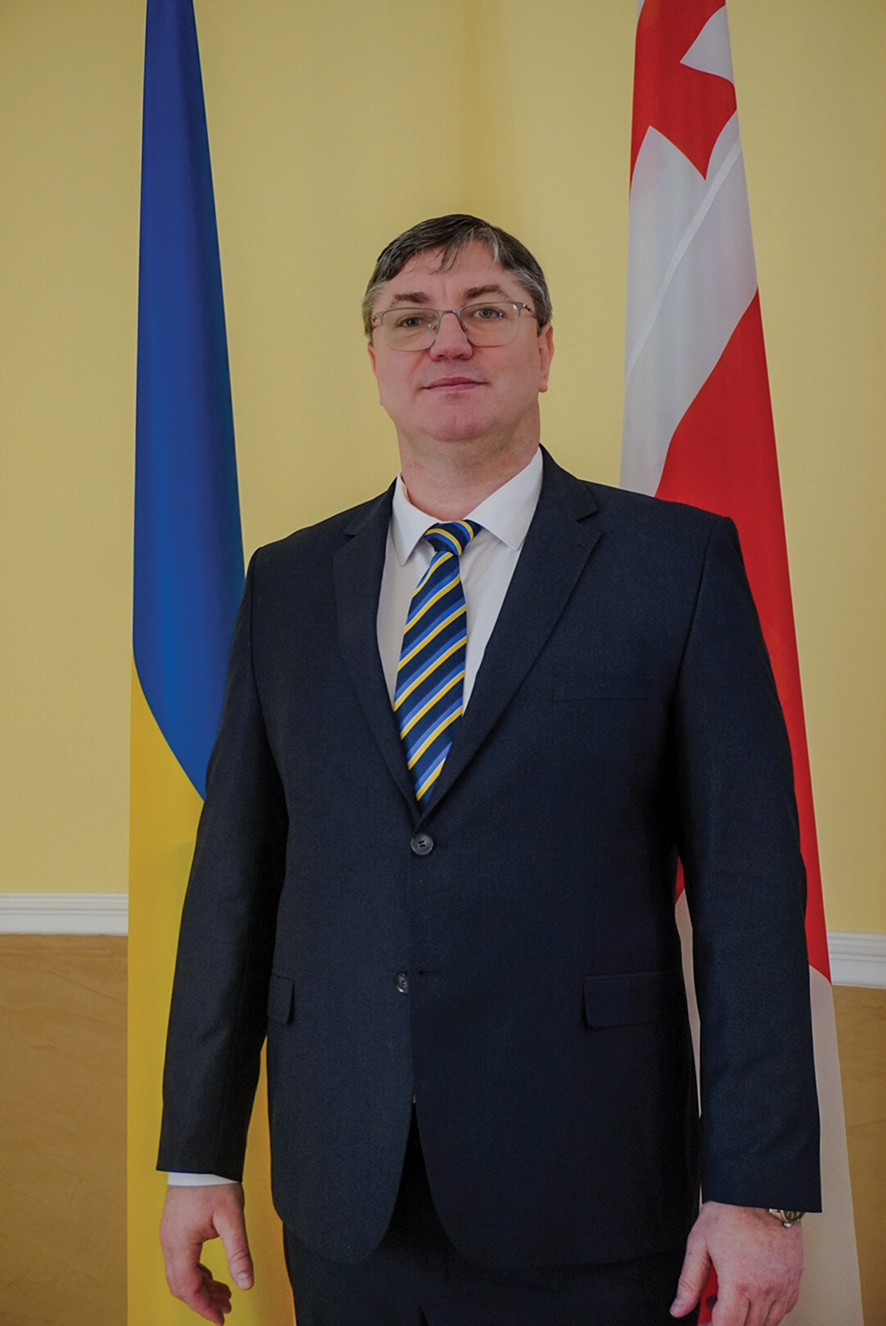
As Ukraine marks four years since Russia launched its full-scale military invasion, we spoke with Mr. Roman Yakovenko, outgoing Charge d’Affaires a.i. of Ukraine in Georgia, about war, resilience, international support, Black Sea security, and his time in Georgia.
When you look back at the past four years of war, what moments stay with you most on a personal level, not as a diplomat, but as a Ukrainian?
When the military invasion began in 2022, I was in Kyiv. This unexpected and horrific act of aggression will stay with me and my family forever. My children were shocked. They looked at me with hope, as if to say: “This cannot be true. It must be a mistake. It must be a nightmare.”
Before that day, I believed the most tragic event of my life was the Great East Japan Earthquake on March 11, 2011, when I was serving as a young diplomat in Tokyo. Today, I understand these events cannot even be compared. War is an absolute tragedy.
Russia’s full-scale invasion of Ukraine has now lasted longer than the 1941–1945 war between the Nazi Third Reich and the USSR. It is a historic and human catastrophe.
Russia continues to intimidate and terrorize Ukrainians by attacking critical infrastructure and residential areas with missiles, multiple-launch rocket systems, guided aerial bombs, and attack drones, resulting in significant casualties and destruction.
Even in 2026, Russia continues its campaign of terror against civilians. Between January 18 and January 25 alone, Russia launched more than 1,700 attack drones, over 1,380 guided aerial bombs, and 69 missiles of various types against Ukraine.
Russia is waging a genocidal war against civilians, committing war crimes and crimes against humanity. It spends enormous sums of money to kill Ukrainians. For example, the total cost of weapons used in the attack on January 20 alone amounted to USD 131 million: equivalent to the annual budget of the Russian city of Veliky Novgorod.
To intercept 800 drones per day across Ukraine, 1,600 Ukrainian interceptor drones are required daily. Each interceptor costs approximately EUR 3,000
As of December 2025, the estimated damage caused by Russia’s war of aggression against Ukraine stands at approximately USD 800 billion, and the figure grows daily.
At the same time, I must emphasize that despite Russian propaganda claims, Russia is not winning and Ukraine is not losing this war. Moscow has failed to achieve a single strategic objective and has suffered enormous losses.
On a personal level, what impressed me most has been the extraordinary cohesion of Ukrainian society and the level of mutual support during the greatest trials in modern Ukraine’s history. But above all, the courage and strength of our soldiers have left the deepest impression on me.
Thanks to their heroism, Ukraine will not only survive: I sincerely believe we will demonstrate rapid development in all areas once this war ends.
Ukrainians have shown remarkable resilience. Where does that strength come from?
Russia uses every day to strike Ukraine, especially targeting our energy infrastructure. Power, heating, and water systems have been under brutal attack by cruise and ballistic missiles and drones. Russia is trying to exploit winter as a weapon.
The situation in the energy sector remains difficult, particularly in Kyiv and the Kyiv region, as well as in the Kharkiv, Zaporizhzhia, Dnipro, Chernihiv, Sumy, and Odesa regions. Despite enormous efforts, hundreds of residential buildings in Kyiv have at times remained without heating, even when temperatures dropped to minus 15–20 degrees Celsius.
Our international partners actively assist in restoring energy infrastructure, and we count on the continuation of this support. Stable energy supply is crucial for the economy, critical infrastructure, and social life. Immediate needs currently amount to approximately USD 1 billion, including generation capacity, mobile substations, backup systems, and other essential equipment.
Ukraine also has significant investment potential in the energy sector and remains open to international partners for the development of distributed generation projects at the local level.
But beyond infrastructure, Ukrainians are a nation of winners: strong and indomitable people. With faith in God and in our state, we must defeat the enemy.
Despite constant shelling, every Ukrainian continues to hold the line, support the army, and do everything possible to bring victory closer.
Where does this strength come from? I am convinced it comes from upbringing, pride in one’s state, national dignity, and deep respect for the Ukrainian nation, culture, language, and religion, all preserved through centuries of struggle.
For a vivid example, one can look at Oleksandr Usyk, the most famous and decorated Ukrainian boxer in the world. He has demonstrated to the world the strength of the Ukrainian Cossack spirit.
What kind of international support matters most at this stage?
Ukraine is grateful for every package of assistance. However, we need a stable and timely supply of all types of weapons and ammunition in larger quantities to ensure Ukraine defeats Russia and that the war does not spread further in Europe.
Our key needs remain unchanged:
• Air defense systems and associated missiles
• Combat aircraft
• Artillery systems and shells
• Long-range missiles
• Electronic warfare systems
• Engineering equipment
• Drones, including those capable of intercepting attack drones
To intercept 800 drones per day across Ukraine, 1,600 Ukrainian interceptor drones are required daily. Each interceptor costs approximately EUR 3,000.
We welcome efforts by our EU and NATO partners to accelerate deliveries.
In addition, Ukraine calls for maintaining the issue of frozen Russian assets on the agenda. These assets represent a powerful instrument to force Moscow toward peace. It is also necessary to strengthen measures against Russia’s shadow fleet and increase sanctions pressure, including the adoption of a strong 20th EU sanctions package.
How has the war reshaped Ukraine’s foreign policy priorities?
Ukraine’s foreign policy priorities have not changed since Russia’s aggression began. European and Euro-Atlantic integration remain our strategic course and are enshrined in the Constitution of Ukraine.
In the Black Sea region, we hope for active participation from Georgia and other regional states in strengthening cooperation through various international platforms.
For example, the Third Black Sea Security Conference will take place in March 2026 in Moldova. It will assess the consequences of Russia’s ongoing aggression and formulate practical recommendations for strengthening regional security and resilience. We expect participation at the highest level from Georgia, Moldova, Türkiye, Romania, Bulgaria, and other countries.
We also look forward to closer cooperation within GUAM and the Organization of the Black Sea Economic Cooperation (BSEC). I would like to take this opportunity to wish success to the Government of Georgia, as it assumed the six-month BSEC chairmanship on January 1, 2026.
We also hope to see the restoration of the Georgia–Ukraine Black Sea ferry connection, which would strengthen economic and strategic ties.
What does a just and sustainable peace mean for Ukraine?
“For Ukraine, peace must be based on the principles of the UN Charter and international law,” Mr. Yakovenko says.
“It means restoring sovereignty within internationally recognized borders, ending the war without losing territories, obtaining real security guarantees from the United States, NATO, and the European Union, punishing the aggressor, and ensuring compensation for damages.
“It cannot be merely a ceasefire. It must make it impossible for Russia to repeat its aggression. Justice must form the foundation of lasting peace.”
Looking Forward: “The Cossack Spirit Will Prevail”
During his time in Tbilisi, Mr. Yakovenko has experienced both solidarity and complexity in Ukraine–Georgia relations.
Georgia has provided humanitarian support, including the delivery of nine industrial generators in late 2025 to help restore electricity in regions devastated by Russian strikes, and thousands of Ukrainians have found temporary refuge countrywide. Around 2,000 Ukrainian children are studying in Georgian schools, where dedicated educational sectors ensure they continue their studies without losing their language or cultural identity. The Ukrainian Houses in Tbilisi and Batumi have become a pillar of community life, dignity, and cultural preservation.
At the same time, Georgia has chosen not to join most Western economic sanctions against Russia, citing its own economic and security considerations. Mr. Yakovenko speaks about this with diplomatic candor.
“Ukraine would, of course, welcome the strongest possible measures against the aggressor,” he says.
“But we understand that every country makes decisions based on its national interests and circumstances. What matters most is that the principles of sovereignty and territorial integrity are upheld.”
He remains deeply grateful for the relationship he has built with Georgia’s Foreign Minister and other officials, describing their cooperation as respectful, open, and constructive. He believes there is significant potential to strengthen ties further, particularly in Black Sea security, economic connectivity, and the eventual restoration of the Georgia–Ukraine ferry link across the Black Sea.
Ukrainians are a nation of winners: strong and indomitable people. With faith in God and in our state, we must defeat the enemy
“Our nations are connected not only by politics,” he reflects. “We are connected by memory, by struggle, by faith, and by culture.”
As his diplomatic mission in Georgia comes to an end, his farewell is sincere.
“Our peoples share a long history of friendship. I am proud of my country, of our ancient culture, our language, and our faith, and I am equally proud of the Georgian people and their resilience. Georgia will remain in my heart forever. Didi madloba, Kartvelebi.”
Considering that Mr. Mykhailo Brodovych was recently appointed by the President of Ukraine to the position of the next Ambassador of Ukraine in Georgia, he wishes all the best and every success to him, and he is sure that Ukraine – Georgia relations will only prosper in the future.
And yet, even in farewell, his focus returns firmly to Ukraine’s future.
He speaks with conviction about a nation that has endured centuries of attempts to erase its identity, yet has preserved its language, its Church, and its sense of dignity.
“We are an ancient European nation,” he says. “We have survived empires, repression, famine, and now full-scale war. The Ukrainian Cossack spirit, our belief in freedom and self-determination, cannot be destroyed.”
He is convinced that when the war ends, Ukraine will not merely rebuild what was lost, but will emerge stronger: modernized, innovative, anchored in the European family, and contributing decisively to regional and global security.
“This war has shown the world who we are,” Mr. Yakovenko reflects. “It has shown our courage, our unity, and our faith. We are defending not only our land, but the principles on which Europe itself stands.”
As Ukraine enters its fifth year of resistance, his message is clear and unwavering:
“Ukraine will endure. Ukraine will rebuild. And Ukraine will prevail.”
Interview by Katie Ruth Davies