Russia’s winter campaign continued to fuse frontline pressure with a sustained air-and-drone offensive this week, as fighting around the Pokrovsk–Myrnohrad axis in Donetsk Oblast remained the most consequential ground contest, while repeated strikes on Ukraine’s energy and transport infrastructure deepened humanitarian strain in major cities. Against that backdrop, US-mediated talks in Geneva ended without a breakthrough, even as Washington described “meaningful progress” on the military track and Kyiv said political issues—territory above all—remain fundamentally unresolved.
On the ground, Russian forces focused on widening and stabilizing gains north and northeast of Pokrovsk and around the Myrnohrad urban area, pressing to stretch Ukrainian defense lines and threaten access routes toward the Dobropillia direction. Independent assessments reported Russian pushes that forced Ukrainian withdrawals from additional settlements north of the Pokrovsk–Myrnohrad agglomeration, though Russian units failed to achieve the deeper breakthrough they have sought toward Dobropillia and also did not force Ukrainian lines in the Hryshyne area northwest of Pokrovsk.
Fighting also remained intense across the broader Donetsk belt east of Kostiantynivka, where Russia’s operational concept has been to grind forward through multiple adjacent “tactical areas” rather than attempt a single decisive penetration. In the Kostyantynivka–Druzhkivka sector, geolocated footage assessed by the Critical Threats Project indicated Russian advances north of Yablunivka, as well as continued pressure designed to expand footholds and probe for weak points through infiltration and small assault groups. In the Lyman–Slovyansk area, the same assessment recorded a marginal Russian advance in central Nykyforivka southeast of Slovyansk and persistent attacks along approaches toward the Siverskyi Donets River line, an area where short windows of weather and terrain conditions can briefly enable crossings and raids.
Further north, Russia sustained activity in Kharkiv Oblast along several directions. The Critical Threats assessment described Russian advances into parts of northern Symynivka and into northern Vilcha northeast of Kharkiv City, alongside continued pressure in the Kupyansk and Borova directions, including an assessed advance in eastern Bohuslavka north of Borova. Along the border regions, Russian forces continued offensive actions in northern Sumy Oblast without confirmed advances, while Ukrainian sources and Russian military bloggers described frequent small-unit contacts and drone-heavy skirmishing that has made movement and resupply increasingly hazardous on both sides.
Ukraine, meanwhile, sought to blunt Russian momentum with local counterattacks rather than broad manoeuvre. The most notable counteraction reported by regional analysts was in the eastern part of Zaporizhzhia Oblast and the neighboring portion of Dnipropetrovsk Oblast. According to the Center for Eastern Studies (OSW), Ukrainian forces reinforced the sector and regained some territory west of the Haichur River—reducing a Russian bridgehead built in previous weeks—and also regained ground south of Velykomykhailivka after crossing the Vovcha River, with up to four settlements reportedly returning to Ukrainian control. A separate counterattack was reported in western Zaporizhzhia between Stepnohirsk and Prymorsk, though OSW noted that some of these areas are described by Ukrainian observers as “grey zones,” complicating precise mapping of control.
While the ground war remained dominated by incremental changes, the air war delivered the clearest strategic signal: Russia is again prioritizing Ukraine’s electricity distribution, heat supply, and railway nodes at scale. On February 12, Russia struck Ukraine with a large wave of drones and missiles, leaving tens of thousands in Kyiv without heating and compounding outages in other cities. Reuters reported that in Kyiv around 3,500 apartment buildings were without heating after the strike, and more than 100,000 families were without electricity according to the private energy firm DTEK; two people were reported injured in the capital. The same Reuters report described severe impacts in Odesa, where successive waves hit energy infrastructure and disrupted electricity, heating, and water supply, with officials stating that nearly 300,000 people were left without water after power disruptions and close to 200 buildings were left without heating.
OSW’s weekly operational overview added detail on the cascading infrastructure effects. It described the February 12 strike as damaging Kyiv’s TETS-5 and TETS-6 thermal power plants and also reported damage at the Prydniprovska thermal power plant in Dnipro, with local authorities in Dnipro reporting four injured, including two children. OSW noted that the situation in Kyiv remained strained days later, with hundreds of buildings still without heating and restoration considered temporarily impossible in a significant portion of the city.
Strikes around Odesa became a recurring feature. On February 13, Ukrainian officials reported a Russian drone attack that killed one person and injured six at one of Ukraine’s Black Sea ports near Odesa, while in Donetsk region three brothers—including an eight-year-old—were reported killed near the eastern frontline, with their mother and grandmother injured. OSW assessed that Russia intensified destruction of energy and transport infrastructure in Odesa and Odesa Oblast, noting repeated hits to substations and infrastructure facilities that cut electricity to tens of thousands of consumers, disrupted water supply, and damaged a railway station, with additional strikes hampering repair crews.
The most consequential single overnight barrage came on February 17, timed as diplomacy resumed. Reuters reported that Russia launched nearly 400 drones and 29 missiles, with strikes affecting 12 regions, leaving tens of thousands without power and heat and killing three Ukrainian energy workers when a drone hit their car near the Sloviansk power plant. OSW reported additional damage from that February 17 strike to energy facilities and railway infrastructure in multiple regions, including hits to the Burshtyn Thermal Power Plant in Ivano-Frankivsk Oblast and disruptions affecting substations and rail nodes; Ukraine’s Air Force was cited as claiming high interception rates during the attack.
Ukraine’s response continued to emphasize long-range strikes against Russian energy and logistics. OSW reported that Ukrainian drones hit a refinery in Volgograd, then struck deeper targets including Ilsky refinery in Krasnodar Krai, and damaged infrastructure around Russia’s Black Sea port facilities. Reuters corroborated key elements of that campaign: on February 12 it reported that a Ukrainian drone attack triggered a fire and forced the Lukoil-owned Volgograd refinery to suspend processing, with sources stating a major crude distillation unit was damaged. On February 17, Reuters reported a fire at the Ilsky refinery after a drone attack, with local authorities saying an oil-products reservoir was damaged; the report also referenced a separate fire in Volna village near the Russian Black Sea port of Taman. Even when such strikes do not produce immediate battlefield effects, they serve a strategic purpose for Kyiv: forcing Russia to allocate air-defense assets to protect refineries, depots, and terminals while stressing fuel supply chains and repair capacity.
Diplomacy ran in parallel, but did not restrain the military tempo. Two days of talks in Geneva between Ukraine and Russia—backed by US mediation—ended on February 18 without a breakthrough. Reuters reported that President Volodymyr Zelensky said he was dissatisfied with the outcome even as Washington described “meaningful progress,” with the most sensitive issues—territory and the status of the Zaporizhzhia nuclear power plant—still unresolved, and no date set for the next round. Ukrainian media reported that Kyiv said US involvement in ceasefire monitoring had been agreed in principle during the discussions, underscoring that any military de-escalation proposal is likely to hinge on credible enforcement mechanisms—an area where Ukraine has consistently demanded stronger guarantees.
International support this week focused heavily on air defense, reflecting the reality that the energy war is now a central front. In Brussels on February 12, NATO states announced hundreds of millions of dollars in support for the Prioritized Ukraine Requirements List (PURL) initiative to supply Ukraine with US weapons, Reuters reported. Germany’s defense minister said Berlin would deliver five additional PAC-3 interceptors for Patriot systems if other countries donate 30 in total, highlighting how scarce high-end interceptor stocks have become across Europe. OSW reported that the latest Ramstein-format meeting assessed the total value of aid pledged for 2026 at $35–38 billion, with significant portions earmarked for air defense and drones; it also outlined additional European funding and procurement plans intended to cover much of Ukraine’s air-defense missile needs through the PURL mechanism. Separately, Zelensky said Ukraine had agreed new energy and military support packages with European allies, with deliveries expected ahead of the February 24 anniversary of Russia’s full-scale invasion.
The operational picture at week’s end is therefore defined by three intertwined dynamics. First, Russia is still gaining ground in critical sectors—especially around Pokrovsk and across parts of Donetsk and northern Kharkiv—yet remains short of the kind of breakthrough that would collapse Ukrainian lines or unlock rapid manoeuvre. Second, the air campaign against electricity, heating, and rail infrastructure is imposing a direct civilian cost and threatening Ukraine’s economic endurance as winter continues, while Kyiv’s drone campaign seeks to impose reciprocal strain on Russian fuel and logistics. Third, diplomacy continues, but it is moving on a separate track from the violence: talks can produce procedural progress on monitoring or technical arrangements, yet the war’s core political dispute—whether Ukraine is expected to concede territory under fire—remains the obstacle that neither side has shown readiness to cross.
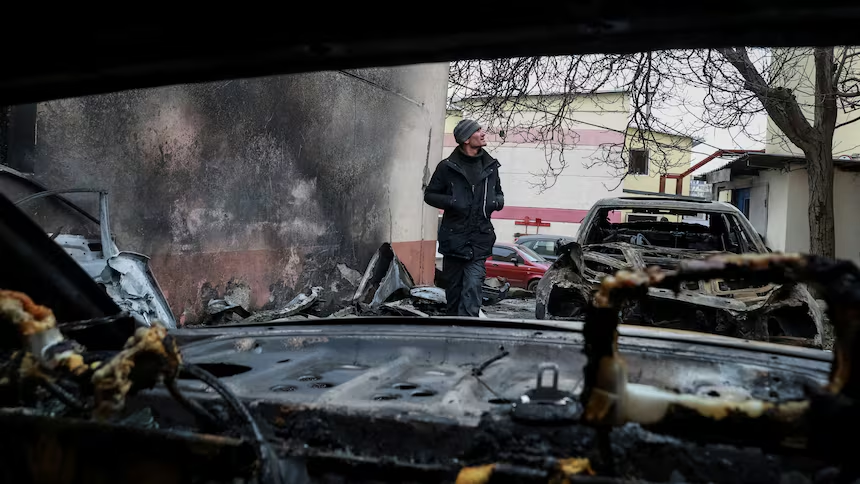
Header image: A resident walks near damaged cars at the site of a Russian drone strike, amid Russia’s attack on Ukraine, in Odesa on Tuesday. (Nina Liashonok/Reuters)