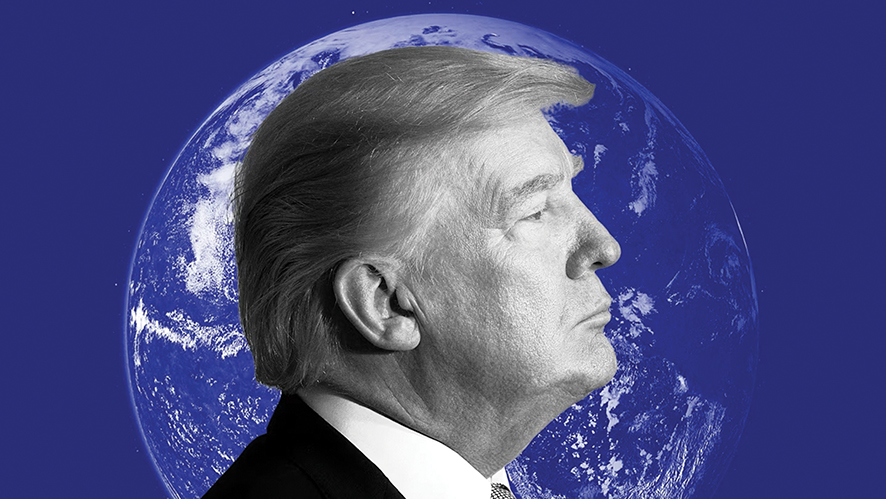
When referring to Donald Trump’s foreign policy, I did not place the word “doctrine” in quotation marks by accident. From the perspective of well-known directions or recognized schools of thought in international relations, it is probably difficult to identify anything “conceptual” or “doctrinal” in the approach of the current President of the United States of America. However, this is only at first glance.
In reality, a substantive discussion of the system-forming components of the foreign-policy style of the Trump administration is both possible and necessary. The material accumulated over the one year that has passed since last year’s presidential inauguration clearly provides a basis for such a discussion.
A New Era?
Over the past one-year period, I have written and spoken many times about Trump’s US policy. To be honest, after several early observations, later corrections proved necessary, in some cases substantively, and in others in terms of terminology and characterization. Nevertheless, the main message has remained unchanged both then and now: Donald Trump’s character, his personal worldview, and the country’s foreign policy stand so close to one another that separating them often seems almost impossible. However, it only seems so.
The Trump phenomenon did not emerge “out of nowhere” and is the result of a rather complex and contradictory process, both inside and outside the United States. Moreover, observation over the past year allows one to say that with Trump’s presidency the world itself, and, with high probability, our country as well, has entered not into a one-time event, but into a process marking the beginning and breakdown of a globally new era. And this has happened in such a way that looking back at the old order only with nostalgic eyes no longer helps in any practical return to it.
Donald Trump’s foreign policy
What are the main, “Trumpological,” characteristics of Trump’s foreign-policy line that distinguish it in substance?
I must begin with what I have already mentioned: Trump’s policy is not self-contained, nor did it arise from nowhere and completely unexpectedly. More than that, it is a “product” of dissatisfaction linked to the lack of effectiveness of the existing order in recent years and its inability to resolve the accumulated acute set of problems.
When speaking about the United States, these problems are generally divided into two categories: first, challenges existing in the country’s domestic life, fiscal issues, immigration, drug trafficking, and others; and second, issues related to the country’s positioning in the international arena. It must also be noted that in the contemporary world domestic and foreign policy are inseparable, and the connection between the two is entirely natural.
However, when speaking about foreign policy, one key aspect has become increasingly clear for certain political groups: the international order based on liberalism was not coping with existing challenges and is not coping with them now. More than that, against the background of the inefficiency of the liberal order, these challenges have deepened, and some have acquired an almost chronic character.
Moreover, the mentioned order increasingly failed to correspond to the interests of its main architect and sponsor, the Western world. At the same time, in parallel with the West’s disappointment, the non-Western world began to derive disproportionately greater benefits from this same order.
As a result, it became necessary to renew and change the rules of behavior characteristic of the liberal order and to offer new ones. Figuratively speaking, it became necessary to place an order for a “new fashion.” It so happened that during the electoral campaign such a заказчик became Donald Trump and his personal worldview considerations. And after his election as president, these considerations, through the use of instruments of power by Trump personally and his camp, became officially declared US policy.
Thus, and for this reason, I believe that Trump himself and the Trumpists are revisionists, and that current U.S. policy is revisionist. I understand that the word “revisionism” may cause discomfort for those who are accustomed to using “revisionist” and “revisionism” with regard to other countries and political leaders.
However, if “revisionism” in essence is nothing other than a review of what exists with the aim of changing it, then current US policy can equally be considered revisionist. And this is an absolutely correct, permissible, and natural assessment.
Provided that we agree that the rules of behavior that had been in force for many years required change, that is, revision, the next important question is how justified such a revision will be, and to what degree and scope.
From this point of view, the alarm associated with Trump’s foreign policy is entirely understandable. The issue is that as a result of an unreasonable, sweeping revision, the existing, however imperfect, system of international relations, based on the fundamental principles of international law, may undergo dangerous deformation. And this is not in the interest of the United States, nor of the West, nor of our country.
Taking this into account, the question arises: where do Trump and his team “sin”? At this stage, as a result of the revision currently underway on the part of the United States, the most vulnerable areas of foreign policy are likely the following:
(a) the weakness of the institutionalization of policymaking; in practice, the resource for conducting foreign policy today is concentrated in the hands of an elite that has nothing in common with elected or other formal positions. As a result, the political process flows out of formal institutions into circles of informal influence;
(b) attitudes toward allied alliances and partners; objectivity requires it to be said that allied alliances have remained so stuck in the past that their reboot has become genuinely necessary. However, here too one must not “throw out the child with the bathwater,” the alarming signs of which are already evident today in various examples. Much can be said about the importance of alliances and partnerships for the United States, but I will single out only a few points:
– through healthy alliances, the United States can project its power far more effectively than in isolation and without allies;
– allied alliances contribute to the preservation of the image and soft power of the United States as a hegemon; hegemony is the nature of any major state and requires appropriate instruments;
– effective alliances will have highly practical value for the United States in relations with other, already existing or emerging, hegemons. Therefore, any excesses in the revision of alliances and partnerships are irreversibly damaging both for the new “setter of fashion” and for partner countries and, overall, for shared interests.
(c) the territorial status quo; this is an extremely delicate topic that may become one of the possible victims of ongoing processes. As a result, this critical pillar of stability in international relations will be undermined, and a trend harmful to the interests of our country will be formed. “Playing” with the inviolability of borders and territorial integrity has nothing in common with pragmatic and rational policy. Moreover, such an approach is fundamentally impragmatic and dangerous, as it weakens and dissipates one of the main stabilizing factors in relations between the Western and non-Western worlds, the territorial status quo.
Trump’s approach is remaining one-on-one with the target, exerting maximum pressure on it, and not overly burdening oneself with allied-partnership obligations
Another aspect that distinguishes Trump’s approach is remaining one-on-one with the target, exerting maximum pressure on it, tariffs and the like, and not overly burdening oneself with allied-partnership obligations.
In this case as well, the strengthening of this new style of the White House administration will likely have a direct impact on:
(a) relations between the United States and its allies and partners; and
(b) the projection of US power in those geographical regions of the world over which other hegemons, based on their understanding of “zones of influence,” will lay claim.
The fact is that such a negative development will also have a negative impact on the planning and development of our country’s national security.
Trump’s version of the “Monroe Doctrine,” its so-called “Donroization,” has caused major controversy regarding the foreign role of the United States.
Here the main question is as follows: by declaring the “Monroe–Donro” doctrine, is the United States limiting itself only to the Western Hemisphere and thereby renouncing the Eastern Hemisphere?
The answer to this question consists of several layers, namely:
(a) I believe that a country such as the United States of America, given its hegemonic nature, cannot limit itself to only one specific hemisphere;
(b) what we call the “Monroization” of US foreign policy can rather be called a real consolidation of foreign policy.
In practical terms, the first stage of such consolidation should be understood as the concentration, that is, consolidation, of resources in the “backyard,” the Western Hemisphere, in order to strengthen a geopolitical bridgehead. As for the next stage, the activation of consolidated resources from the strengthened bridgehead in the rest of the world, this will take place under conditions of strict prioritization.
In short, the US example demonstrates what we, in Georgian politics, are obliged to make a rule:
– a pedantic inventory of resources;
– prioritization of tasks with a cool head;
– proportionate allocation of resources to tasks defined as priorities.
One of the hallmarks of contemporary foreign and domestic policy is the use of political instruments for concrete goals, without any ideologicalization. The Trump administration and the elite close to it openly offer this new tonality. We too should support this tonality.
When mentioning the modern version of the Monroe Doctrine, I referred to the “backyard” rather indelicately. This time I will try to elaborate on this issue more diplomatically.
The matter is that according to one of the dominant geopolitical views, the unified platform of the “two Americas,” North America and South America, is regarded by the United States as an inseparable part not only of its foreign but also of its domestic policy.
With regard to domestic policy, Trump, more distinctly than several of his predecessors, believes that the roots of the challenges existing within the United States, drug trafficking, uncontrolled migration, organized crime, and so forth, lie not only in “one,” but also in the “second America.” As a result, in order to practically restrain these challenges, it is in the interest of US national security to control processes in “both Americas.”
It is acceptable that this approach comes very close to governing the world according to zones of influence. However, I believe that here we are talking only about approximation, and not about the United States closing itself within the Western Hemisphere as its zone of influence. As to why, I have already spoken about this in relative detail: the United States, like any superpower, is doomed to involvement in global processes. What is at issue are only new methods and styles of this involvement, which I have also discussed.
To summarize…
Trump’s “doctrine” is probably epochal. It is also clear that historical parallels can be found for it.
However, it is equally clear that contemporary realities endow it with a distinctiveness and identifying character peculiar only to it.
It is also clear that Trump’s “doctrine” cannot be neatly titled. Various elements converge in it simultaneously, globally transactional and nationally populist-nationalist. And they converge in such a way that in real politics such a coexistence of these elements, given their incompatibility, would previously have been hard to imagine.
What should guide Georgia?
The study of doctrinal currents is necessary and useful. Relevant knowledge helps us better understand the external world and to bargain for our national interests within it.
I used the word “bargain” deliberately. The highly egoistic and ruthless environment surrounding us should not be softened or embellished in description. Any such softening or embellishment will relax us, distract our attention, and lead us down the wrong path.
Therefore, for acquiring academic knowledge, yes to doctrinal studies; but in practice, rational calculation aimed at tangible benefit. From the standpoint of benefit, Georgian politics should be based on two main principles:
1. the strongest possible economy;
2. the strongest possible security.
If you wish, these two principles may be considered the “doctrine” of Georgian politics, based on healthy egoism and realistic capabilities.
And as the foundation of this policy, we should understand patriotism in such a way that the definition of interests and the possibilities for achieving them respond to one another in a timely and proper manner.
Analysis by Victor Kipiani, Geocase Chairman