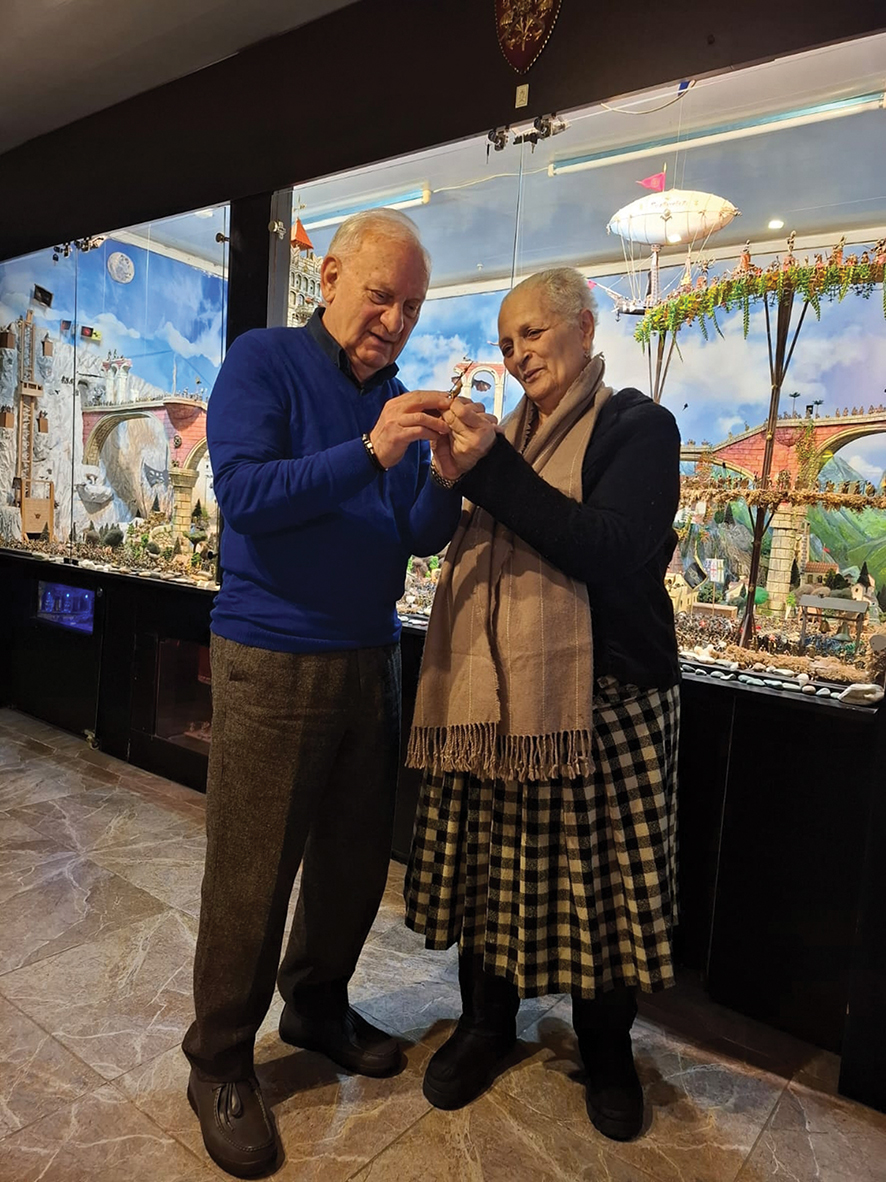
There is an absolutely enchanting petite realm of miniature tin figures right in the heart of our beautiful capital city—7 Dadiani Street, off Freedom Square. I could hardly believe my eyes when I saw what I saw at the Yota Royal Gallery. The place is an unlikely little basement of a typical old downtown Tbilisi building, with a slight smell of moisture and stairs and walls asking for refurbishment, but packed with amazing samples and illustrations of world history and the valuable annals of Sakartvelo. Nothing like this exists in the country, or possibly in the world! As an idea, I would only compare it with the celebrated Madame Tussauds Museums around the globe.
On top of the accumulated wide-scope historical lore, thousands of uncannily sculpted minuscule figures of renowned personalities of international fame, masterful art, subtle design, knowledgeable graphics, and architectural phantasy—the place astonishes a visitor with the titanic labor invested in this outstanding project, created with knowledge, skill, love, and self-sacrifice. The collection is not simply interesting and attractive. It is also truly educating and terribly entertaining. Once you are there, you want to stay there forever.
According to the great Russian scientist I.P. Pavlov, collecting is not merely a hobby, but a specialized, intellectual, and scientific effort that allows for the discovery of new, previously unfamiliar knowledge. Indeed, you leave the place not just pleasantly impressed, but truly packed with newly acquired knowledge that could someday prove to be very useful in life. This is why, I would say, not one child in town should be left without having visited this fairylike mini-spot in the land.
Most of these tin figures are soldiers of various ranks and nationalities. World history has preserved the story of Brothers Maurice and William of Orange, the brilliant Dutch military strategists, who used the silver soldiers, deployed on a table, to rehearse the order of battle, which helped them defeat the Spanish military, thus winning the independence of their country. Since the past of humankind qualifies as the history of wars, the usage of toy soldiers was quite common in many national combative cultures, including that of the Egyptian pharaohs.
The exhibit at the Yota Royal Gallery is a subtle replica of the famous historical episodes of that kind. The entire show is staggering, nested in a copious exhibit window and illuminated accordingly. I can’t imagine a better ancillary educational material than this wonderful gallery. If I were the current Georgian educators, who are so eager to reform the system, I would put the spot into the middle- and high-school curriculum and give schoolchildren a chance to go through this secular educational communion. Learning history by means of having fun and acquiring knowledge at the same time—especially because the pleasure is totally free of charge—is something really practicable. Wouldn’t this be a truly contemporary educational endeavor?
The mini-tin-soldiering, as entertainment and the method of battle rehearsing, has a long history in various countries. As a matter of fact, there is no room in a regular newspaper article to reminisce about it in black and white, but for those who might get interested, the Internet is literally infested with relevant material. By the way, this is not a business, not even a small one, but it needs to be maintained for the interested people to have access to it, so breaking even is the dream of the current owners.
In the finale, I would rather introduce the family who has created this miracle and is taking care of it now: Grigol (Grisha) Robakidze is the author of the idea, designer, and architect of this miraculous exhibit; his wife Irma is his dedicated assistant in all the matters that be; and his mother Nana is a brilliant bilingual custodian and guide whose profuse knowledge of history makes the visit to the Gallery a genuine piece of pleasure, mixed with knowledge of history, unobtrusively and benevolently presented in thirty minutes at most.
The family is ready to give up the Gallery in favor of the State of Georgia, as an auxiliary academic instrument for the reformed education system of the country, provided the government finds a better and safer place for it. Grigol is ready to be the honorary director of the Gallery, asking for zero remuneration. The proposal seems quite rational. What is now left is the potential deal to be signed.
My verbal storage and content have become totally Trumpesque, which, hopefully, is more or less forgivable. In a word, a deal between the Yota Royal Gallery and the Government of Georgia should comfortably fit into the ongoing process of the much-talked-about educational reform in the country. A deal is a deal is a deal!
Blog by Nugzar B. Ruhadze