In Tbilisi this winter, architecture is temporarily relieved of its usual burden: it no longer has to justify itself through square meters, budgets, or seismic codes. Instead, it appears flickering on a screen, unstable, poetic, and strangely vulnerable. The screening cycle Film and Architecture, hosted at Art Foundation AFA Cinema Hall and curated in collaboration with Irina Kurtishvili, reads less like a thematic film series and more like a careful cultural intervention—one that asks a deceptively simple question: how does cinema teach us to inhabit space?
Running from late January through mid-March, the program assembles a canon where buildings are never mere backdrops. They breathe, dominate, decay, seduce, and occasionally betray their inhabitants. This is architecture as fate, as ideology, as erotic object, as ghost.
For a city like Tbilisi—where Soviet modernism, post-Soviet improvisation, and speculative glass towers coexist in permanent tension—this question lands with particular force. Watching films about cities elsewhere becomes a way of thinking about the city at home, without the defensive reflexes that usually accompany local debates on urban development.
The program opens with Concrete Love – The Böhm Family, a portrait of architectural lineage that treats modernism as a family inheritance rather than a stylistic doctrine. Here, concrete is intimate, almost tender—an idea that resonates quietly in Tbilisi, where béton brut still carries the unresolved emotions of the twentieth century.
Michelangelo Antonioni’s Zabriskie Point follows, detonating the American desert into a landscape of eroticized alienation. Architecture, in Antonioni’s hands, becomes the ultimate modernist trap: clean lines, open plans, emotional vacuum. The film’s relevance today feels uncomfortably fresh, especially in cities learning to equate visibility with value.
By the time we arrive at REM, architecture has fully merged with celebrity, speed, and intellectual branding. The figure of Rem Koolhaas hovers over the program like a benevolent disruptor, his thinking echoed again later in Koolhaas Houselife, where the myth of the starchitect dissolves into dust, leaks, and domestic choreography.
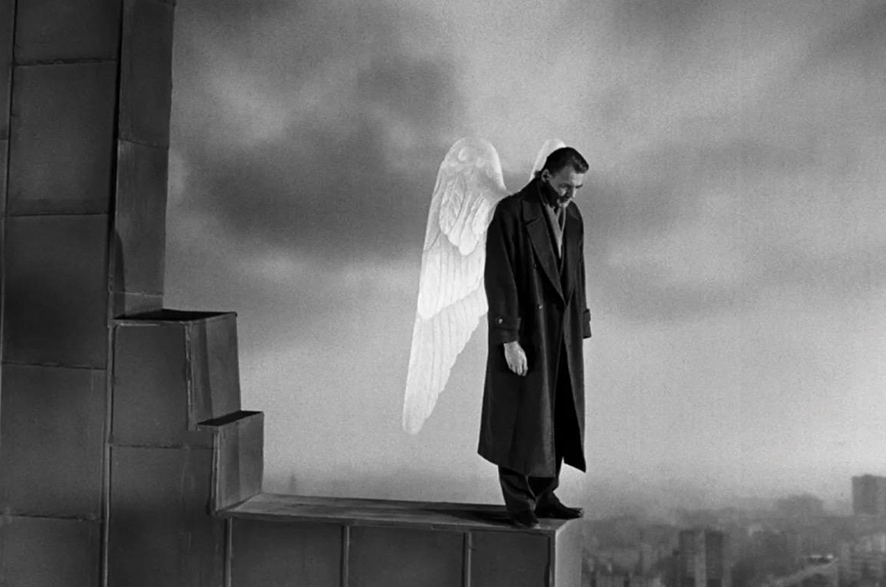
The emotional core of the cycle arrives with Wings of Desire, Wim Wenders’ Berlin elegy, where architecture becomes a listening device. Libraries, rooftops, and empty lots absorb human thought like sponges. Watching this film in Tbilisi today—another city layered with invisible histories—feels less like nostalgia and more like recognition.
Villa Tugendhat shifts the gaze inward, into one of modernism’s most fetishized domestic spaces. The house is immaculate, rational, and emotionally perilous. The film quietly exposes the cost of architectural perfection: a life that must constantly adapt itself to an idea.
Sarah Morris’s Rio returns the programme to the contemporary city as a system—color-coded, surveilled, endlessly patterned. It is urbanism as abstraction, the city flattened into data and rhythm, a condition familiar to anyone watching Tbilisi’s accelerating transformation.
The cycle closes with Death in Venice, Luchino Visconti’s slow, devastating meditation on beauty, decay, and architectural melancholy. Venice here is not scenery; it is destiny. A city so heavy with aesthetic meaning that it crushes those who seek purity within it.
What makes Film and Architecture significant in the Georgian context is its refusal to localize too quickly. These films are not about Tbilisi, yet they speak directly to it. They offer a language—visual, emotional, theoretical—for discussing space without reducing it to politics or profit. The post-screening discussions, conducted in Georgian, extend this gesture, translating global cinematic thought into local intellectual currency.
Irina Kurtishvili’s curatorial logic is precise and patient. Rather than proposing architecture as salvation or cinema as critique, the programe allows both to remain unstable. Architecture emerges as something that shapes subjectivity over time. Cinema becomes the medium that makes this shaping visible.
In a cultural moment where Georgia’s urban future is often narrated in extremes—heritage versus development, past versus future—this series introduces a third register: attention. To watch closely how others have filmed their cities is to learn how to look again at one’s own.
For a few Thursdays, in a cinema hall on Zurab Avalishvili Street, Tbilisi becomes a city watching itself indirectly. And sometimes, that is the most honest way to see.
By Ivan Nechaev