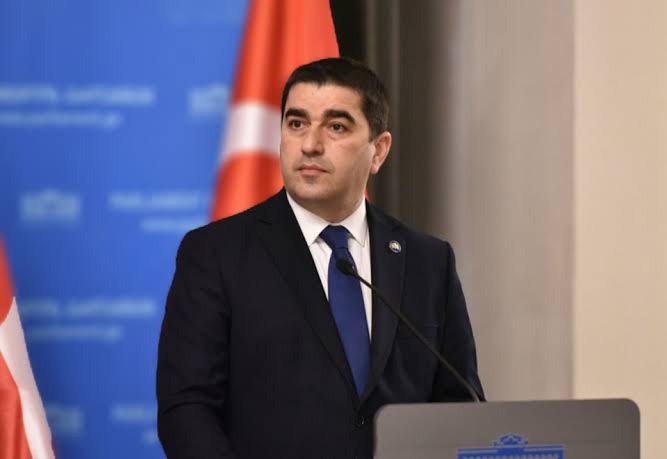
Georgian Parliament Speaker Shalva Papuashvili has criticized statements made by Moldovan President Maia Sandu, arguing that they reflect skepticism about Moldova’s ability to integrate into the European Union as an independent state.
In a Facebook post, Papuashvili said that when a country’s president openly considers voting against the country’s independence, “everything becomes clear,” adding that “in this respect, yes, we are ahead of Moldova.” He claimed that Georgia’s European integration has always been envisioned as a path that strengthens statehood rather than dissolves it.
“What can we do? We are not giving up our three thousand years,” Papuashvili wrote, referring to Georgia’s long history of statehood. “This is proof that if you believe in your national identity, even a so-called ‘small country’ can establish and preserve its own statehood amid historical turmoil.”
The Parliament Speaker interpreted Sandu’s remarks as an indication that she doubts Moldova’s prospects of joining the EU independently and instead considers a scenario similar to that of the German Democratic Republic (GDR), which entered the European Union automatically upon reunification with the Federal Republic of Germany. “This, too, is a way to Europe — but by losing sovereignty,” Papuashvili stated.
He went on to draw a parallel with domestic debates in Georgia, warning that what he described as “hyper-Europeans” might be willing to cede Georgia’s sovereignty immediately by citing Article 78 of the Georgian Constitution, which enshrines the country’s commitment to European and Euro-Atlantic integration. “For them, no article is worth an article before Article 78,” Papuashvili said. “For us, the issue is simple — Georgia’s European path is the path of an independent state, not its abolition.”
In a postscript, Papuashvili also recalled that on October 4, during what he described as the storming of the Georgian presidential palace, Maia Sandu publicly expressed support for groups involved in attempts to overthrow the government, a claim that has previously been part of heated political exchanges between Georgian and Moldovan officials.
The comments followed recent remarks by Maia Sandu in an interview with the British podcast The Rest Is Politics, in which she said she would support unification with neighboring Romania if such a referendum were held. Romania is a member of both the European Union and NATO.
“If we have a referendum, I would vote for the unification with Romania,” Sandu said, explaining that ongoing regional instability and Russian pressure make it increasingly difficult for Moldova to survive as a democratic and sovereign state. “Look at what is happening around Moldova today, look at what is happening in the world. It is becoming increasingly difficult for a country like Moldova to exist as a democracy, as a sovereign country,” she noted.
Moldova, like Georgia, has been granted EU candidate status, but both countries face complex internal and external challenges on their paths toward European integration. Sandu’s remarks have reignited debate over whether small states under geopolitical pressure can safeguard democracy and security through independent EU accession alone, or whether deeper integration — even at the cost of sovereignty — should be considered.