One of the added bonuses of being back in Svaneti during winter is, of course, winter itself, a thing hardly touching Tbilisi at all by comparison. This recent, ‘Rustavi 2’ TV channel-inspired return to our village and house gave us a wonderful chance both to reconnect with friends there during the Christmas season, and also for me to reunite with ice, snow and water and get many new photos of these phenomena.
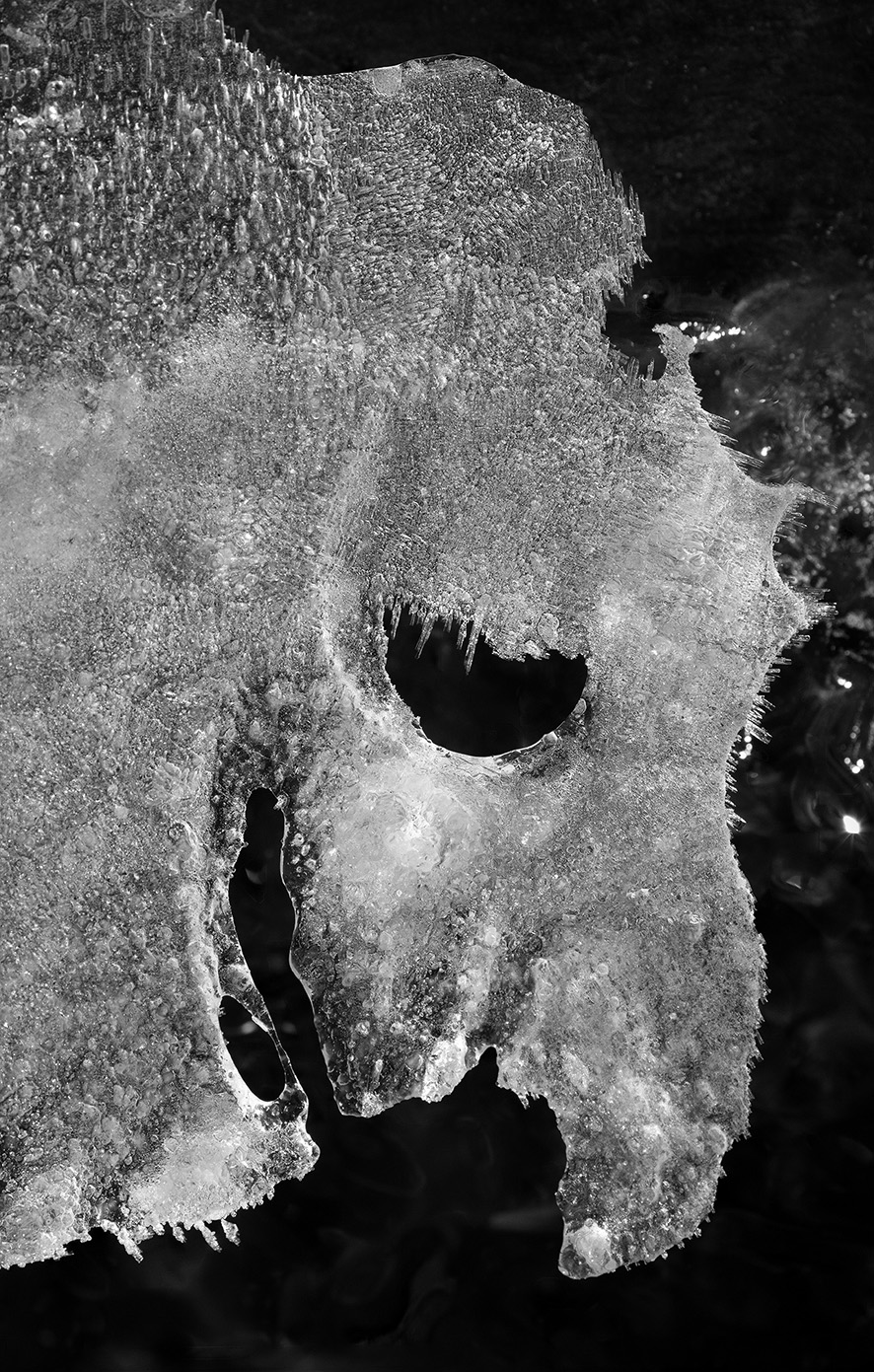
Once the forecast brief snowfall was done, skies cleared for practically our whole week there, which sent nighttime temperatures to as low as -13 degrees C. Plenty cold enough for morning shooting while everything was still frozen, once the sun came up after 9 am.
I remember an early quote describing the work of one of my favorite science fiction writers: something like “The universe might be pretty strange, but it’s going to have a tough time outdoing Greg Egan.” Now I can beg to differ. The forms I am seeing in mere ice, not the endless but consistently 6-fold symmetries of snowflakes, are about as diverse as anything I can imagine, and beyond that, too. Mostly organic as opposed to “regularly” geometric; reminding me of microscopic creatures, such as viruses or bacteria.
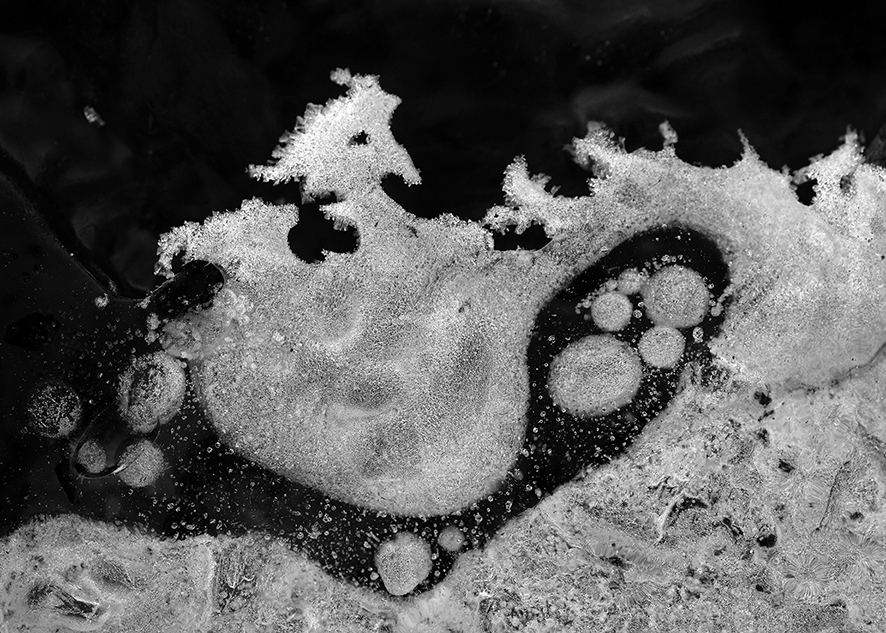
The places I get to see ice’s wonders include: stream edges where there is stillness instead of fast flow. Puddles. Frost on car windows. Accumulations of ice from splashing stream water. These three types of location give me all the strangeness and wonder I can handle. Two atoms of H and one of O (the water molecule) provide unending fantasy, especially when they freeze.
Sunlit ice gives vastly different results from ice in shade; so I wait for the sun to come up and work its contrast-adding magic, although I can shoot the same scene in both conditions, to compare. However, once the sun IS on the ice, my clock is ticking down to melting.
I usually look out for forms of other things in the ice, and am never disappointed. Creatures real or imaginary, cute or monstrous, are always ready to be found. Textures and patterns are another favorite. But many times I find myself making up names: Bubble Fish. Winter is Coming (Ice Zombie). I also realize that the greater turbulence of river- or stream-edge ice gives far more variation to its forms than ice in ponds or puddles, although these stiller-water ices still manage to be infinitely rich too. A “smaller” infinity?
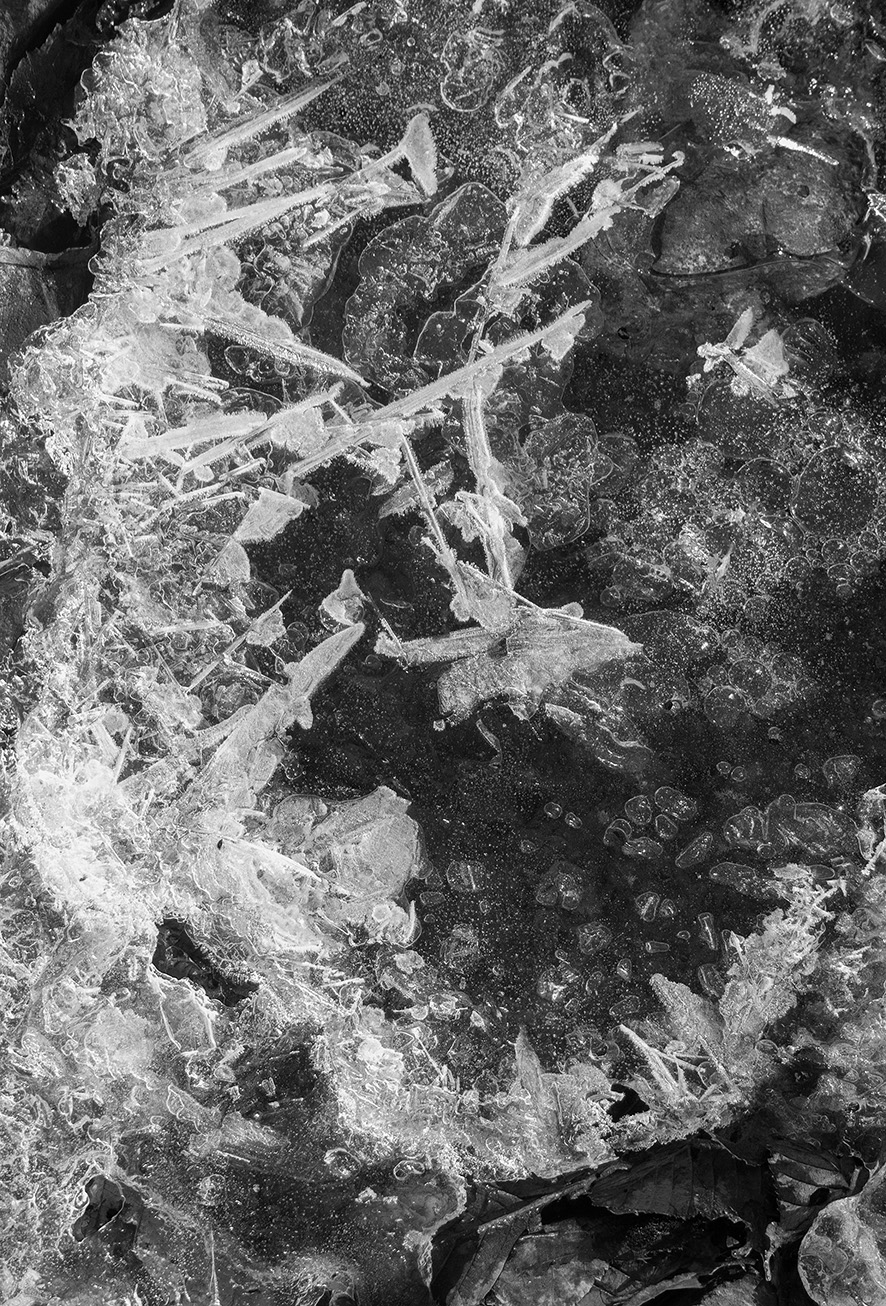
I suppose that the best written descriptions of what I find will be poetry rather than prose; it’s that exotic and wild. But maybe the pictures, each worth a thousand words minimum, are enough.
A new thing I was trying this time was very long exposures of flowing stream water contrasting with still ice. For this I needed two things I rarely use: a neutral density filter, and a tripod. The filter lets me shoot exposures of 30 seconds, or longer if I want though this is plenty. The tripod keeps the camera absolutely steady during these long shots, so that the still elements remain sharp (I can hand-hold for a sharp shot down to about 1/8 second with. short, light lens; not more).
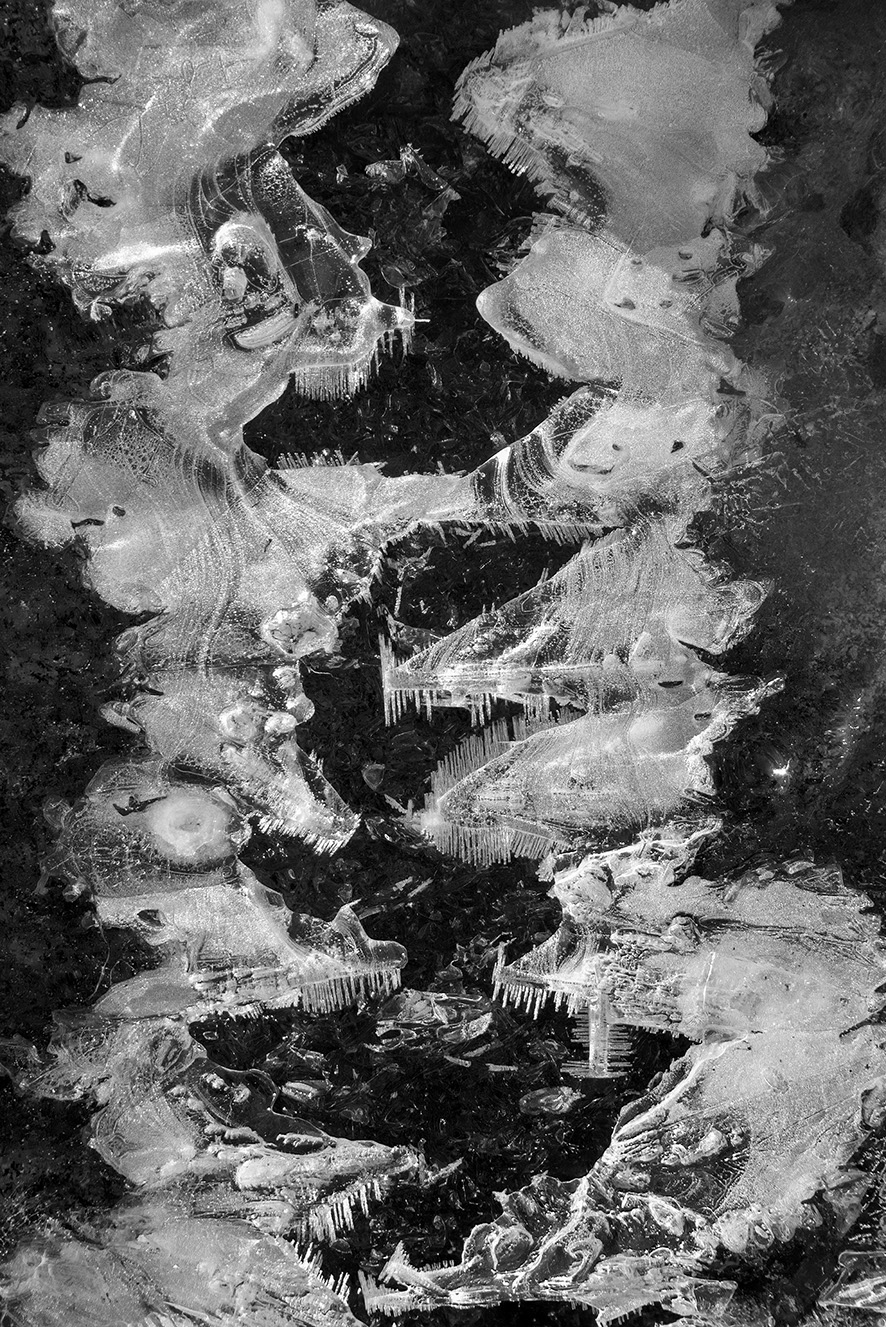
So: compose the scene with camera on tripod, and lock its position. Focus, and lock that. Carefully screw the filter on, not changing focus in the process. And shoot. I usually make multiple exposures, because the scene is often too contrasty not to either blow out the highlights or lose the shadows into solid black. Then, on Photoshop, I combine these differently exposed frames for what’s called HDR: high dynamic range. Finally, though I do leave a color version of the scene for reference, convert it to my preferred black and white, and adjust the contrast. Done.
This long-exposure process is quite intensive, with all its steps, and I was experimenting to see how things would turn out, with a few pieces I’m pleased with and a few failures from which to learn. The ice detail photography is much simpler: 4 hand-held shots, combined and enlarged in Photoshop, turning 24 megapixels into an astounding 96 or so for huge printing if I want it, then again conversion to monochrome from color. But these workflow descriptions do little to convey the sheer wonder, which I should mostly let speak for itself.
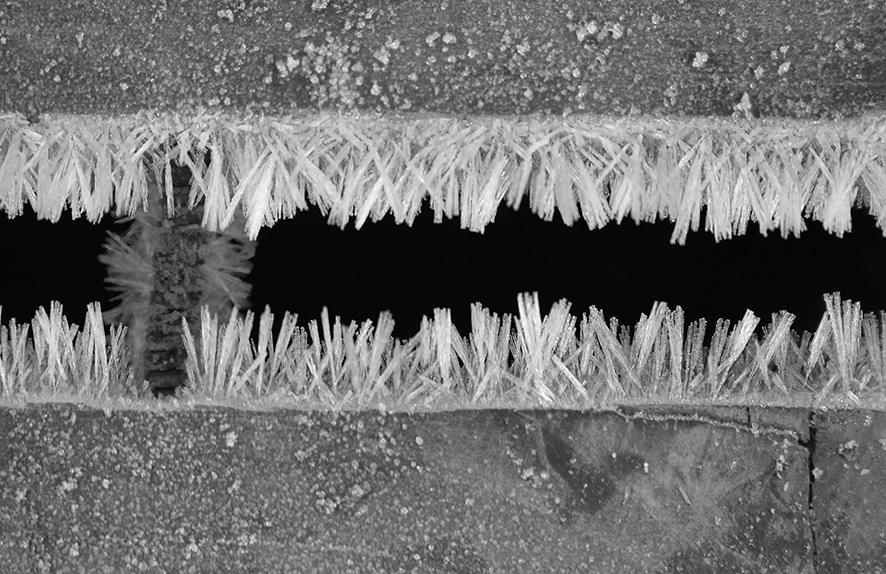
Although I am mostly (in the detailed, close-up ice shots) dealing with flat planes, to which I try to make the camera’s sensor parallel for sharp focus everywhere, I still worry use another “computational photography” technique. This is called focus stacking, where usually a tripod-mounted series of frames, with only their focus changed, are combined in Photoshop. With focus stacking, it is essential that the subject be perfectly still for the series of frames; and use of a tripod helps ensure this. But my 2x enlargement, described in the previous paragraph, depends on NOT having tripod-mounted frames. My hand-held shots do have the auto-focus changing slightly for each, due to slight body and camera movement between shots. These combine nicely to give me more in focus, at the tiny distances I am using for these macro pieces.
Enjoy, and Merry Christmas!
Blog by Tony Hanmer
Tony Hanmer has lived in Georgia since 1999, in Svaneti since 2007, and been a weekly writer and photographer for GT since early 2011. He runs the “Svaneti Renaissance” Facebook group, now with over 2000 members, at www.facebook.com/groups/SvanetiRenaissance/
He and his wife also run their own guest house in Etseri: www.facebook.com/hanmer.house.svaneti