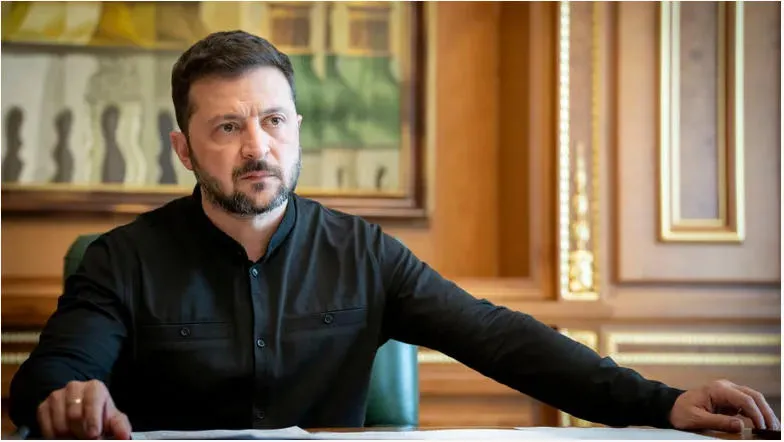
Ukrainian President Volodymyr Zelensky has unveiled a 20-point peace plan, describing it as a “framework political document” intended to serve as the basis for a comprehensive peace agreement involving Ukraine, the United States, Europe, and Russia.
Speaking to journalists, Zelensky said he is ready to discuss the draft document, emphasizing that it is political in nature rather than a finalized treaty.
“I am now ready to consider the draft of a 20-point document. This is a political document between us, the United States, Europe, and Russia,” Zelensky stated.
Ukrainian president says consensus has not yet been reached with the American side on two key issues: the status of Donetsk region and the future governance of the Zaporizhzhia Nuclear Power Plant.
Zelensky outlined the main elements of the proposed agreement, starting with the reaffirmation of Ukraine’s sovereignty, which all signatories would formally recognize through their signatures.
The plan calls for a full and unconditional non-aggression agreement between Russia and Ukraine, accompanied by the establishment of an international monitoring mechanism along the contact line to ensure the sustainability of long-term peace.
Under the framework, Ukraine would receive strong security guarantees. The Ukrainian Armed Forces would maintain a peacetime strength of approximately 800,000 personnel. The United States, NATO, and European signatory states would provide Ukraine with security assurances comparable to NATO’s Article 5 collective defense clause.
Russia, in turn, would legally formalize and ratify a policy of non-aggression toward both Ukraine and Europe through domestic legislation.
The document also envisions Ukraine’s accession to the European Union within a clearly defined timeframe, alongside a major global development package focused on investment and economic growth.
To support post-war recovery, multiple funds would be established for Ukraine’s economic reconstruction and regional rebuilding, with a target of mobilizing up to USD 800 billion.
Ukraine would accelerate negotiations on a free trade agreement with the United States and reaffirm its commitment to remaining a non-nuclear state in line with the Treaty on the Non-Proliferation of Nuclear Weapons.
The framework proposes joint management of the Zaporizhzhia Nuclear Power Plant by Ukraine, the United States, and Russia, though Zelensky noted that details on this arrangement are still under discussion.
Territorial issues remain unresolved, with several potential approaches outlined:
-
One option recognizes the de facto contact line based on current troop positions in Donetsk, Luhansk, Zaporizhzhia, and Kherson regions as of the date of the agreement, under international supervision.
-
Another option involves creating a demilitarized free economic zone in Donbas, which would require a referendum. Ukraine opposes withdrawing its troops under this scenario.
-
Zelensky said territorial matters could ultimately be resolved at the leaders’ level.
Both Russia and Ukraine would commit not to alter territorial arrangements by force in the future.
Russia would pledge not to obstruct Ukraine’s commercial use of the Dnipro River and the Black Sea.
A humanitarian committee would be established to facilitate the return of prisoners of war, political detainees, and abducted children.
Ukraine would be required to hold national elections shortly after the signing of the agreement.
The peace framework would be legally binding, with implementation overseen by a newly established Peace Council, to be chaired by US President Donald Trump.
Once all parties formally approve the agreement, a full and immediate ceasefire would come into effect.
Zelensky concluded by stating that he is awaiting Russia’s response to the proposed framework, signaling that Kyiv is prepared to move forward if reciprocal political will is demonstrated.