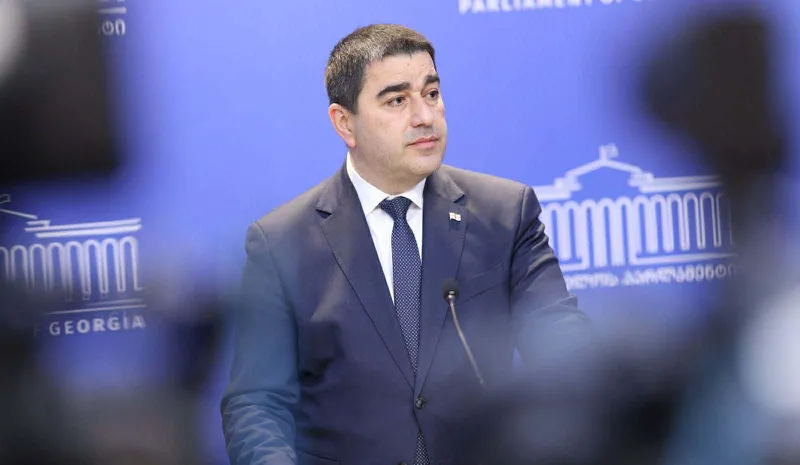
Speaking to journalists about the potential suspension of visa-free travel with the European Union, Speaker of Parliament Shalva Papuashvili said that responsibility for such a development would not lie with the Georgian authorities. He sharply criticized the EU’s approach, arguing that it has become political and instrumental rather than legal or procedural.
Papuashvili claimed that visa-free travel is increasingly being used by the EU as a political tool. He described this approach as part of what he called the “Estonization” of the EU’s foreign policy, claiming that European integration mechanisms are no longer driven by procedures or people-to-people engagement, but by political pressure.
“In this context, it is difficult to rule anything out,” Papuashvili said. “There are discussions about imposing restrictions, separating groups of people, and labeling them. For example, if certain officials or groups are required to obtain visas while others are not, visa-free travel could be suspended selectively. From a legal perspective, this amounts to segregation — treating different groups within a country differently. Europe has experienced such practices in the past. If Brussels is intent on leading Europe back toward this dark chapter, we can already see the trend: labeling so-called international ‘offenders’ without court rulings or due process, and imposing sanctions. This is what I mean when I say Brussels is steering the EU toward a civilizational dead end.”
Commenting directly on the possibility of visa-free travel being suspended, Papuashvili said expectations of logic or fairness from Brussels are misplaced.
“We should not expect reason or justice in Brussels’ decisions,” he stated. “For some time now, decisions have been guided by a political agenda rather than principles. Various issues are being used as leverage. Fortunately, the EU lacks the political maturity to cause serious damage to Georgia.”
Papuashvili further claimed that previous attempts by EU representatives to influence Georgia’s internal political processes had failed, citing what he described as interference by ambassadors, foreign ministers, and EU officials during elections. He said those efforts were unsuccessful and contrasted them with the stance of the new US administration, which he claimed rejected such interference.
“The EU now appears to be trying to act as a global enforcer,” Papuashvili added. “But it lacks both the qualifications and the capacity to inflict real harm. The Georgian people clearly understand the intentions of certain actors in Brussels toward Georgia.”