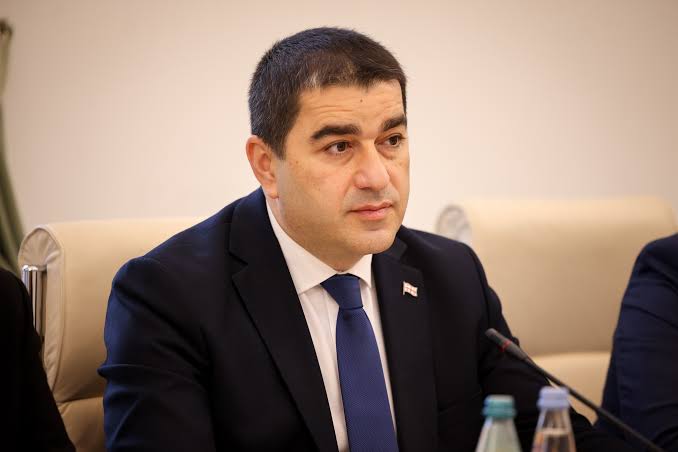
Speaker of Parliament Shalva Papuashvili says there can be no political neutrality when it comes to terrorism, arguing that parties offering support—or even ambiguous positions—pose a direct threat to democratic institutions.
In a statement published on social media, Papuashvili recalled that it has been ten days since a senior member of the Strong Georgia–Lelo political alliance was detained on suspicion of carrying out a terrorist act.
“He has admitted to the crime and confirmed his political motive,” Papuashvili wrote. “Under these circumstances, distinguishing him from a terrorist should require neither a reminder nor any additional explanation.”
Speaker claimed that terrorism — one of the gravest crimes with a clear international dimension — cannot be reinterpreted for political convenience or framed through party loyalty or ideological justification.
“Against this backdrop, a political party referring to someone involved in a terrorist offense as an ‘ally’ raises serious legal and ethical concerns,” he said. “This is no longer just a moral dilemma; it reflects an improper distancing from terrorism that fundamentally contradicts the principles of a democratic state.”
Papuashvili noted that Lelo is a member of the Alliance of Liberals and Democrats for Europe (ALDE), and that within the European political space, justifying or failing to strongly condemn terrorism is incompatible with democratic standards.
“In this context, responsibility extends beyond a single political party,” he said. “It also applies to the international political union to which the party belongs. ALDE’s position on this matter is not merely about internal loyalty — it is a test of European political and legal norms.”
He added that the issue carries even greater weight given that high-ranking European Commissioners, including Kaja Kallas and Marta Kos, come from political families within the same alliance.
“This matter goes beyond the internal Georgian context and takes on a broader European political significance,” Papuashvili wrote.
He pointed to EU Directive 2017/541, which prohibits the justification of terrorism, ideological support for terrorist acts, and granting public legitimacy to such acts. The directive also states that encouraging terrorism or expressing political solidarity with terrorists can trigger legal responsibility.
“The conclusion is clear,” Papuashvili emphasized. “There is no political neutrality toward terrorism. Parties that endorse terrorism or maintain ambiguous positions pose a direct threat to democracy.”
Aleko Elisashvili, leader of the Citizens party and a well-known opposition figure, was arrested in late November on suspicion of planning and organizing a terrorist act. State Security Service of Georgia (SSG) says the case concerns an alleged plot involving an explosive device intended for political destabilization.
The SSG claims that Elisashvili coordinated discussions related to the attack and that investigators obtained audio and video material purportedly confirming his involvement. Elisashvili has denied wrongdoing, calling the accusations fabricated and politically motivated.
Following his arrest, he was placed in pre-trial detention while the investigation continues. The case has sparked strong political reactions, with government officials pointing to the seriousness of the charge, while opposition parties accuse authorities of using counterterrorism measures for political repression.