From 1 January 2026, Georgia will outlaw the production, import, and market placement of single-use plastic tableware — forks, knives, lids, stirrers, polystyrene cups, containers, straws. What looks like a regulatory footnote is, in fact, a profound cultural event.
When governments decide what citizens may touch during the most intimate daily ritual — eating — they reconfigure not merely the market but the very grammar of social life.
Anthropologists from Mary Douglas to Marcel Mauss argued that mundane objects often carry the densest symbolic charge. A disposable fork is more than a utensil: it is a condensed ideology of convenience, speed, and extractive temporality, the material avatar of late-20th-century consumption logic. The state intervening in this micro-object is therefore intervening in the temporal regime of society itself.
From EU Directives to Japanese Cultural Minimalism
Georgia’s decision is not an isolated gesture. It mirrors the EU Single-Use Plastics Directive of 2019, which banned polystyrene food containers, stirrers, and cutlery across member states. But the European genealogy only partly explains the logic. The deeper cultural resonance lies elsewhere.
Japan, an unexpected but illuminating parallel, has long cultivated a ritualistic relation to everyday objects — mono no aware, the emotional sensitivity to the ephemerality of things, prescribes respect, not disposability. The aesthetics of wrapping (tsutsumi), the etiquette of bento, the philosophy behind refusing unnecessary packaging, all give cultural legitimacy to political restrictions. In Japan, the state rarely bans; culture self-regulates through social expectation and shame.
The EU, by contrast, uses a juridical imagination: law as the sculptor of behaviour.
Georgia’s step aligns it with this European model of state-driven ecological behaviour engineering, signalling to society that modernity now means regulated restraint rather than unbounded convenience.
Convenience as a Post-Soviet Desire
To understand the coming tensions, we must turn to sociologists of material culture such as Zygmunt Bauman, who linked disposability with the “liquid modernity” of unstable identities and accelerated consumption. In Georgia, this carries a distinctly post-Soviet inflection.
Disposable plastics became widespread in the 1990s precisely because they embodied a break from scarcity. Where Soviet households cherished reusable enamel mugs and glass jars, plastic was the sign of Western abundance, mobility, cheapness, freedom from washing, freedom from the past.
Georgia’s ban strikes at this symbolic residue. It implies a transition from post-scarcity euphoria to ecological responsibility, a psychological migration many societies experienced — France in the 2000s, Italy in the 2010s, the Baltic states after 2019.
The regulation will require a cultural unlearning: a shift in how convenience is valued, how speed is judged, how food-on-the-move is imagined.
Anthropology of the Kiosk and the Mobile Stall
The decree explicitly applies not only to restaurants but to “any stationary or mobile food outlet”—from Kakhetian roadside mtsvadi stalls to Tbilisi festival kiosks.
This is where anthropology becomes crucial.
Street food in Georgia is a communal performance of hospitality. A plastic cup of compote at a festival, a polystyrene bowl of kharcho on a cold evening — these were makeshift symbols of shared space. Removing the vessel changes the choreography.
Historical parallels:
India’s ban on styrofoam plates (several states, starting 2017) forced street vendors to return to traditional solutions: pressed-leaf plates (patravali), clay cups (kulhads), woven-reed baskets. Anthropologists noted a revival of local crafts and micro-economies.
Rwanda’s 2008 plastic bag ban—one of the earliest in the world—triggered new artisanal packaging industries and altered everyday consumption rituals.
Mexico City’s 2021 ban reshaped street taco culture, pushing vendors toward paper and biodegradable containers, but also exposing the fragility of micro-business margins.
Georgia’s roadside and festival food culture may experience a similar cultural re-materialisation. A return to clay? To wood? To biodegradable vine or cornstarch containers? The ban implicitly asks: What is the Georgian equivalent of the kulhad? What indigenous material culture will fill the vacuum left by plastic?
Statecraft, Power, and the Intimacy of Regulation
Michel Foucault taught us that modern power operates through biopolitics — governing populations through habits, health, hygiene, and behavior. Banning plastic forks sits firmly within this tradition of subtle behavioral governance.
This regulation asserts that the state may determine: how citizens eat, with what materials, under what environmental obligations.
Georgia thus joins the global shift toward ecological governmentality, seen in: France’s 2016 ban on plastic cups and cutlery, Canada’s 2022 phase-out of single-use plastics (later challenged in court), Kenya’s sweeping 2017 ban, one of the world’s strictest.
The Georgian case is culturally distinct because it intervenes in a society negotiating multiple modernities at once: a European aspiration, a Soviet inheritance, a Caucasian environmental fragility, a tourism-fueled consumption economy.
Waste, Memory, and the Archaeology of the Future
Archaeologists often remind us that ancient garbage is among the best-preserved cultural artefacts.
Plastic, in this sense, is a material that colonizes the future. Hannah Arendt wrote that modernity is defined by our relationship to “things that outlast us.” Plastic outlasts us too much, creating an unethical temporal footprint.
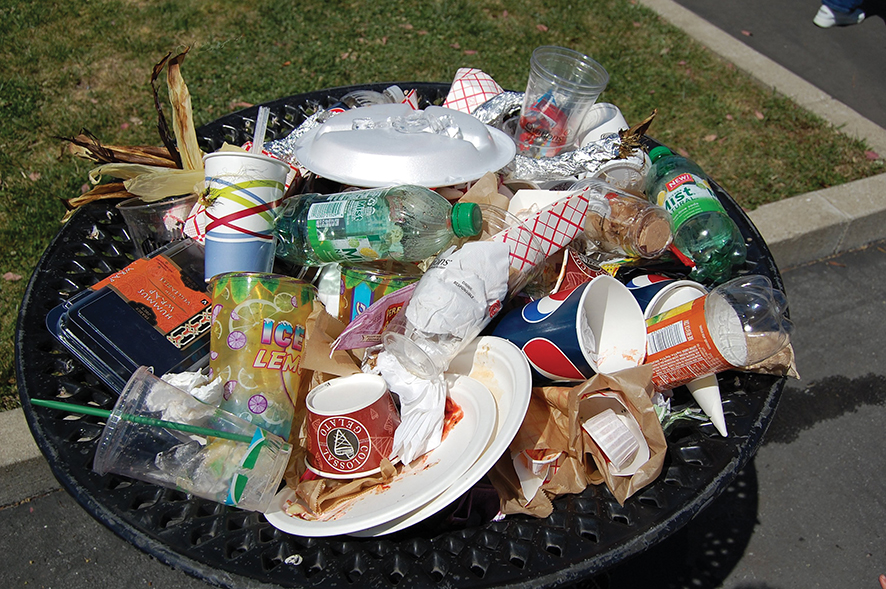
Georgia currently consumes ~612.5 million single-use items annually. The regulation attempts to redraw Georgia’s future archaeological landscape — to prevent the stratigraphy of the 21st century from being a polymer archive.
It is, in essence, a temporal policy: a law addressed to people who are not yet born, made by people who are alive now but thinking in geological time.
Who Pays for Culture Change?
Every ban reveals inequalities. Small shaurma shops, festival stalls, and mobile kiosks operate on razor-thin margins. Plastics are cheap; biodegradable alternatives cost more. Countries that moved early — like Rwanda, France, Taiwan — often supplemented bans with subsidies, municipal procurement, or cooperative production schemes. Without similar scaffolding, the cultural burden falls disproportionately on small businesses.
The Georgian decree includes a transition window:
3 months to sell previously stocked items,
6 months to continue using plastic containers for food deliveries to eateries,
1 year for other plastic food-contact materials.
This temporal buffer is a form of economic anthropology: the state trying to manage culture change without provoking market panic.
But successful transitions elsewhere show that cost is reshaped primarily through scale, innovation, and public value formation. When cultural meaning shifts — when consumers perceive reusable and biodegradable materials as “modern,” “ethical,” or “aesthetic” — demand drives price down. This is cultural economics, not merely supply-chain management.
What Should a Georgian Fork Look Like?
The deeper cultural challenge is symbolic: What material culture will now represent Georgian everyday eating? Italy answered this through the revival of compostable cellulose. India answered it with leaves. Japan answered with disciplined minimalism. Northern Europe answered with design-driven eco-aesthetics.
Georgia must answer it too — ideally by rediscovering its own historic craft epistemologies: traditional woodcarving in Guria and Racha, clay and ceramic traditions from Shida Kartli and Kakheti, woven plant fibers used in rural food transport, vine-based biodegradable crafts, already a dormant cultural resource.
If the state supports local material innovation, the ban could stimulate a renaissance of Georgian craft modernism — a fusion of ecology, design, and heritage.
From the Disposable to the Durable
Georgian society stands at an inflection point: a transition from the logic of disposability to a logic of durability.
Cultural theorists like Hartmut Rosa argue that modernity suffers from “social acceleration” — everything must be faster, lighter, easier. Disposable plastics are the purest expression of acceleration.
Regulating them is, paradoxically, an attempt to slow society down: to make consumption deliberate, not automatic; thoughtful, not frictionless.
This is where the ban becomes civilizational rather than environmental. By altering the material infrastructure of eating, Georgia reshapes: urban sensibilities, rural practices, tourism aesthetics, marketplace behaviors, the unconscious habits of everyday life.
Will This Create a New Environmental Public?
Political theorist Bruno Latour argued that ecological transformation requires not only new laws but new “publics” — collectives united around shared material concerns. Plastic bans create such publics by materializing the ecological crisis in every hand and every mouth. Each missing fork is a civic reminder.
Georgia’s regulation, therefore, is more than waste management. It is a political invitation to imagine a different society: one in which responsibility is materially inscribed in every act of eating.
Whether the invitation is accepted will depend on: state support, cultural creativity, market adaptation, and the emergence of a new ethic of material stewardship. If successful, 1 January 2026 will be remembered as the day Georgia began to eat the future differently.
By Ivan Nechaev