Between 2000 and 2006, while Georgia was undergoing profound political change and redefining its identity on the global stage, there existed one rare, meticulously protected sanctuary capable of receiving international political leaders, renowned diplomats, global celebrities, business magnates, and cultural icons at the highest level. That enclave was Arcadia, the private estate of Badri Patarkatsishvili.
In the aftermath of a devastating civil war, Georgia lacked the infrastructure, security facilities, and hospitality complexes necessary to host high-level foreign guests with the required discretion and safety. Arcadia Palace, therefore, became a unique geopolitical stage. Through its guarded gates came world-class figures, and within its walls, Georgia — emerging from a turbulent past — found a secure and dignified venue for its first confident steps onto the global map.
The Arcadia estate comprises two distinct grand buildings, the Palace and the Hall, separated by a landscaped park. The Palace was built in 1984 by renowned Georgian architects Victor Djorbenadze and Vazha Orbeladze. Arcadia Hall (Darbazi) was constructed in 2002, commissioned by Badri Patarkatsishvili and his wife, Inna Gudavadze, and designed by architect Tamaz Tkheshelashvili. Though different in style, both structures were built using local materials and inspired by Georgian architectural traditions.
Arcadia is many things at once: a venue created entirely from Georgian resources yet housing treasures from around the world; a quiet retreat steeped in the history of high-level negotiations; an artistic sanctuary in which works unseen in any museum are preserved; and, ultimately, a living symbol of what one individual’s vision can create for an entire nation.
A Portrait of the Founder
To understand the creation of Arcadia, one must look closely at the life of Badri Patarkatsishvili, a figure whose influence extended across media, business, philanthropy, and national culture.
In the 2000s, already a successful businessman, he devoted much of his time and resources to philanthropy and heritage restoration. His initiatives led to the revival of important cultural landmarks such as the Chavchavadze House Museum, the Lado Gudiashvili House, and the Dadiani Palace, enriching Georgia’s historical and cultural landscape. His sponsorship of expeditions between 2002 and 2008 to Jerusalem and India in search of the remains of Saint Ketevan further demonstrated his commitment to both cultural preservation and spiritual legacy.
Arcadia is a quiet retreat steeped in the history of high-level negotiations; an artistic sanctuary in which works unseen in any museum are preserved
His final months were spent in the UK, where he died of a heart attack in London on February 12 2008, at the age of 52. Arcadia remains one of the most enduring reflections of his personality — a space shaped by ambition, generosity, sophistication, and a profound desire to elevate Georgia’s cultural presence on the world stage.
Arcadia Palace
One of the most architecturally fascinating structures on the estate is Arcadia Palace, a masterpiece of late Soviet modernism created in 1984 by architects V. Dzhorbenadze and V. Orbelidze as a wedding venue.
In the chaotic 1990s, it was occupied by armed groups and left in severe disrepair. By the time Mr. Patarkatsishvili intervened, the structure was nearly unrecognisable.
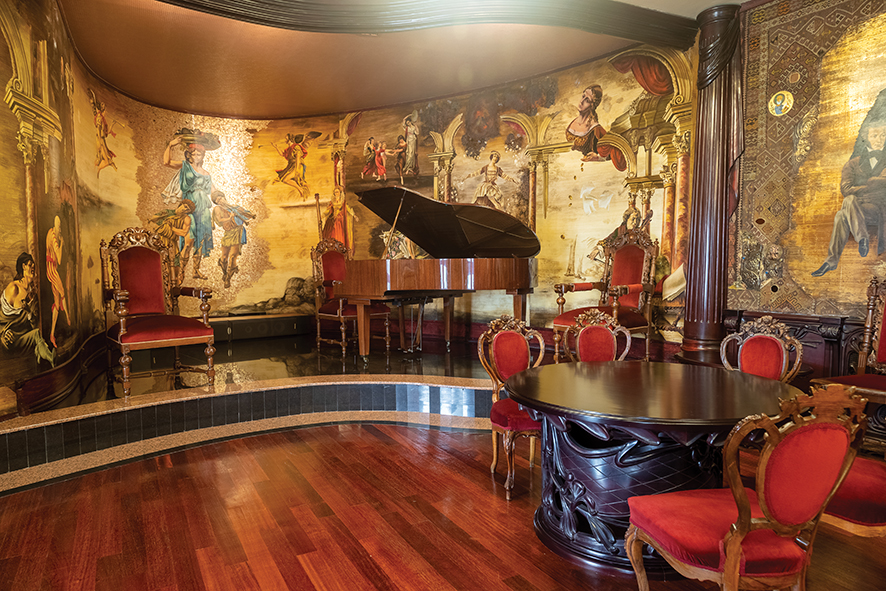
The transformation he commissioned — under his close daily supervision — included the creation of themed meeting rooms that combined architectural mastery with storytelling. Architects Tkheshelashvili, Kinkladze, and Shvelidze collaborated with orientalist Thea Chovelidze, who travelled to China and Turkey to collect authentic references for the interiors. In just six months, they created some of the most atmospheric and culturally resonant rooms in Georgia.
The Chinese Hall is crafted entirely from blackwood, soaked in water to achieve the desired texture and colour. Its motifs of dragons and water — symbols of life, strength, and continuity — animate the space.
An authentic gong invites visitors to make wishes, while the floor creates the illusion of flowing water.
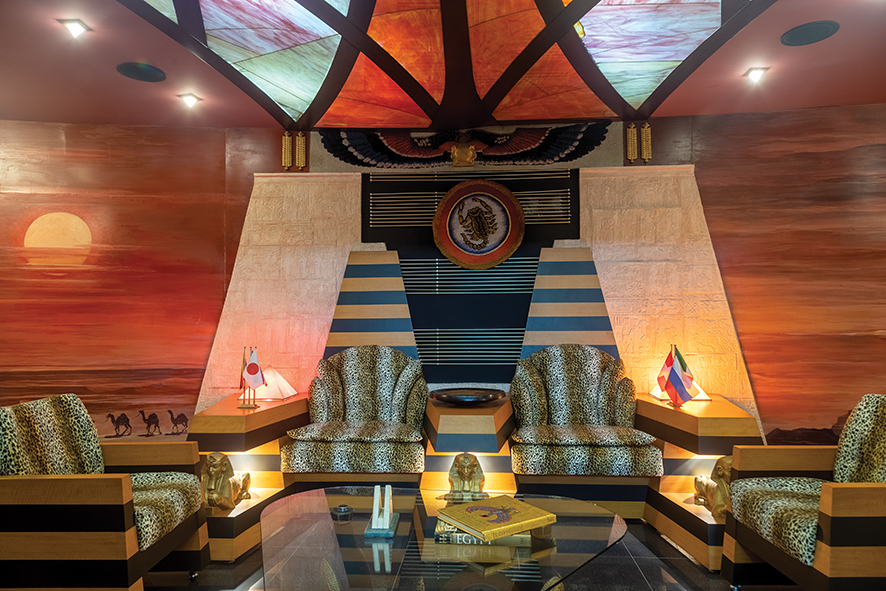
The Egyptian Hall draws from ancient spiritual symbolism: statues of cats representing sunlight and fertility, a pyramid-shaped table, a depiction of Cleopatra, and a ceremonial chalice echoing the mythical quest for the Holy Grail.
The most used entrance of the Palace meets the visitors with a faithful reproduction of the Jerusalem fresco depicting Shota Rustaveli. The restoration of the original fresco in Jerusalem was undertaken at his initiative, reflecting his dedication to Georgian cultural heritage beyond national borders.
Over the years, the palace hosted countless prominent figures, including Michel Platini, Shimon Peres, Anna Politkovskaya, Leonid Parfyonov, as well as ambassadors, diplomats, ministers, journalists, and business leaders from around the world.
The Creation of Arcadia Hall (Darbazi)
When Mr. Patarkatsishvili purchased the land adjacent to the Palace, there was nothing to suggest its future grandeur. At the time, the plot was occupied by Khari Kharalo, a shabby local restaurant. What he envisioned, however, was extraordinary: a palace built exclusively from Georgian materials and based on the principles of traditional Georgian architecture.
Inna Gudavadze suggested the central concept — a great circular hall with a perimeter gallery and a welcoming inscription on the walls in four languages: Latin, Georgian, Hebrew, and Russian: “Peace to those who enter.”
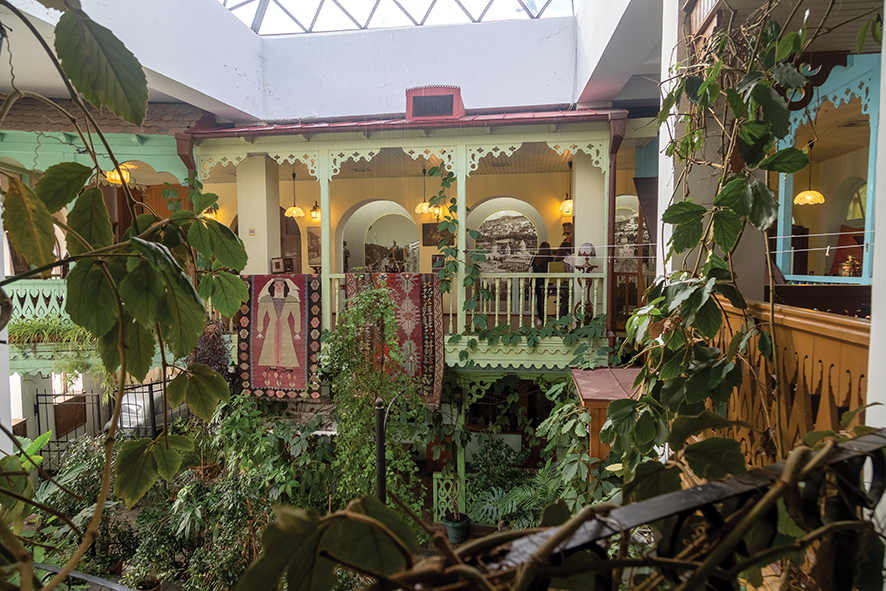
To bring this vision to life, he entrusted architect Tamaz Tkheshelashvili with a mission that was both artistic and ideological. The result is a structure unlike any other in the world, as it cannot be replicated. Every stone, every wooden panel, every ornamental detail originated from Georgian land and Georgian craftsmanship.
Its gates are now open for guided tours led by expert guides who narrate the stories behind each room, each artefact, and each architectural detail
Inside, the ceiling echoes the traditional gvirgvini (crown) structure of old Georgian houses. The massive stones in the centre of the hall, arranged like natural sculpture, were placed on the site before construction, and the palace was built around them. Above, a carefully engineered chandelier can be lowered on a cable — a poetic fusion of tradition and modern engineering.
Art Within Arcadia: A Private Museum Without a Public Equivalent
Arcadia Hall houses a private collection of national treasures and rare artefacts assembled by Mr. Patarkatsishvili. His passion for collecting was deeply tied to his sense of personal and national identity.
Among the most extraordinary objects is the 1712 first printed edition of The Knight in the Panther’s Skin, published at the first printing house in the Caucasus. Preserved behind glass, this priceless relic forms part of a broader collection of editions gathered from around the world and reflects his desire to safeguard the literary foundations of Georgian culture.
The estate also holds original works by Lado Gudiashvili, the central figure of Georgian modernism. These private sketches, unseen online, in museums, or in archives, exist only within Arcadia. They trace Gudiashvili’s journey from his early years in Tiflisi to his transformative period in Paris, where he encountered Picasso, Modigliani, and other artistic giants. His later style — a blend of Georgian folklore, emotional symbolism, and surreal imagery — became iconic.
Suspended in the round gallery under soft chandelier light, these works transform the space into a living museum where Georgia’s artistic soul is quietly preserved.
The Park
Surrounding Arcadia is a park that bears little resemblance to the abandoned garden that once was here. When Badri decided to expand the territory, he asked Inna to take care of the neglected grounds.
Together with her brothers, she travelled to the Lappen plant nursery to select suitable plants.
Lappen Baumschulen, the renowned German tree nursery near the Dutch border, has a long history of cultivating trees for transplantation across continents. Founded in 1894, it sits at the crossroads of four countries and is famous for relocating mature trees to new climates.
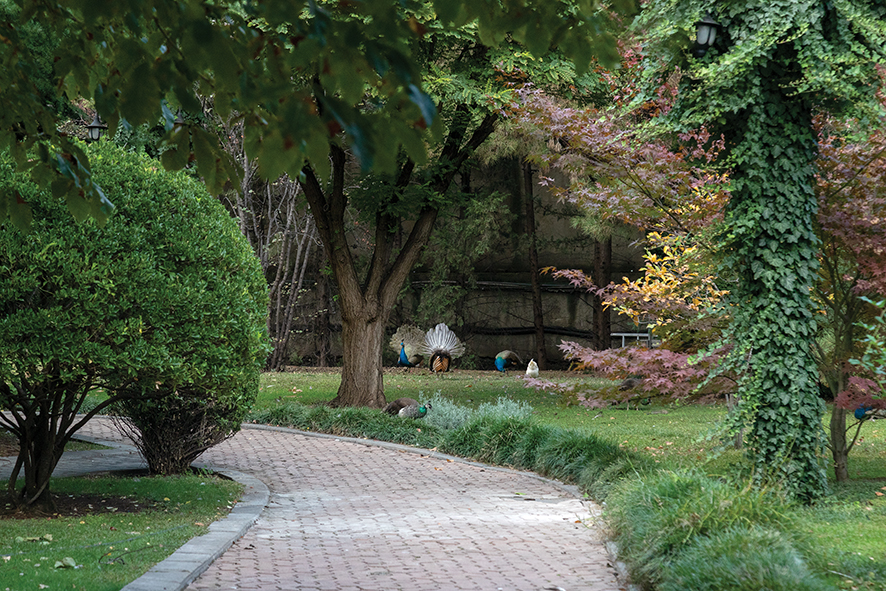
Four enormous trucks delivered the selected trees to Arcadia. Among them was a sequoia, already towering over the landscape, Japanese sakuras and enormous cone taxuses.
Peacocks roam the lawns and perch on the trees, lending the park a regal serenity. Some approach the estate’s fences, yet none fly over them. Their presence recalls the anecdote of Emperor Nicholas, who, upon being advised to clip the wings of his swans, replied: “They will not fly away — they are well-fed.”
Arcadia’s park remains a place of calm movement and quiet majesty.
The Automobile Collection: A Retrospective on Wheels
Within the grounds rests a remarkable collection of vintage automobiles, each representing a different chapter in history. Among them are armoured Mercedes vehicles personally used by Mr. Patarkatsishvili, capable of withstanding even a grenade launcher — a testament to the security concerns of that era.
The collection also includes vehicles from the Garage of Special Purpose, once used by the Soviet and post-Soviet elite. Cars driven by Yuri Gagarin and a Dnipro motorcycle from Leonid Brezhnev’s escort are displayed alongside two Daimlers reminiscent of those used by the British royal family.
A classic 1980s Bentley and a rare Excalibur further enrich the exhibit. Designed in Milwaukee by David and William Stevens, the Excalibur cars were hand-built for collectors seeking distinctive elegance. Named after King Arthur’s legendary sword, they embody a fusion of mythology and mechanical artistry.
A beautifully preserved Studebaker completes the display, paying tribute to a company that evolved from horse-drawn carriages to early petrol vehicles. Together, these automobiles transform the collection into a journey through the history of engineering and prestige.
Arcadia Today: A Living Legacy
Though still a private estate, Arcadia continues to function as one of Georgia’s most extraordinary cultural environments. Its gates are now open for guided tours led by expert guides who narrate the stories behind each room, each artefact, and each architectural detail. Visitors are encouraged not merely to observe, but to feel the atmosphere and imagine the figures who once walked these halls.
Both buildings serve as venues for exclusive cultural and private events, offering a level of refinement rarely found in the region. Their interiors and landscaped grounds attract couples from near and far, making Arcadia a sought-after location for wedding photography and private celebrations of all styles.
Most importantly, Arcadia has emerged from a period of stillness following Badri’s passing and has undergone extensive and expensive renovation. It has become an active, living part of Georgia’s cultural present. It honours his legacy while welcoming new generations to discover its beauty, history, and meaning.
It remains a sanctuary where art, architecture, memory, and national identity converge — a place that once hosted the world’s most prominent figures and now offers insight into the enduring spirit of Georgia through one of its most remarkable private estates.
By Kesaria Katcharava