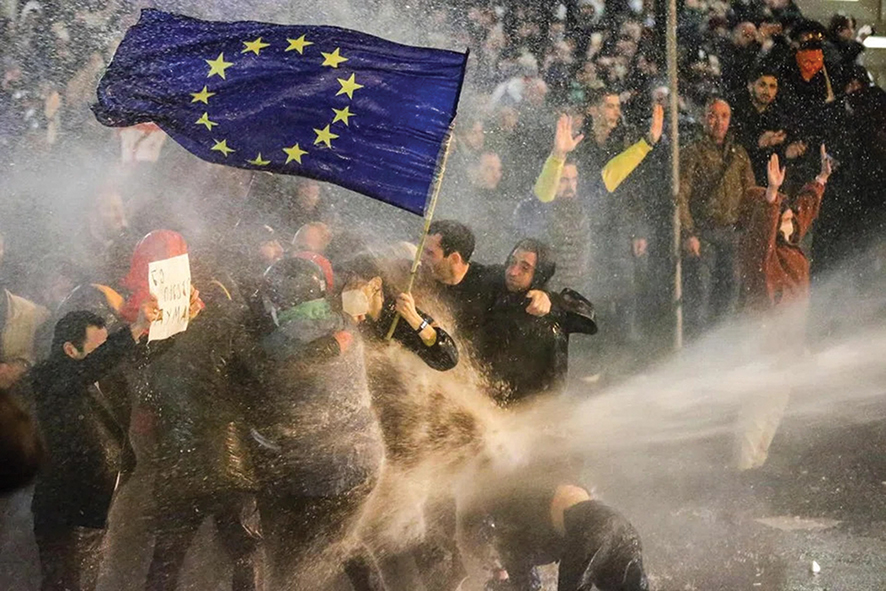
The BBC this week published an investigative report suggesting that the Georgian government may have deployed a discontinued, World War I–era chemical agent to suppress anti-government protests in late 2024. According to the report, demonstrators opposing the government’s suspension of EU accession experienced severe symptoms—including burning eyes, shortness of breath, coughing, and vomiting—that persisted for weeks.
The Alleged Chemical: Camite
Expert analysis consulted by the BBC indicated that the symptoms were consistent with exposure to bromobenzyl cyanide, historically known in French military terminology as “camite.” Camite was developed by Allied forces and used by France against Germany during World War I, but was reportedly discontinued in the 1930s due to long-lasting health effects and replaced by modern tear gas (CS gas).
Evidence from Whistleblowers and Documentation
Whistleblowers, including former riot police weaponry chief Lasha Shergelashvili, suggested that the chemical may have been mixed into water cannons used during the November–December 2024 protests in Tbilisi. Shergelashvili noted that the compound had effects far more potent and long-lasting than tear gas.
The BBC obtained a December 2019 inventory list from Georgia’s Special Tasks Department referencing two unnamed substances: Chemical liquid UN1710 and Chemical powder UN3439, with mixing instructions. UN1710 was identified as trichloroethylene, a solvent used to dissolve chemicals in water, while UN3439 is an umbrella classification for industrial hazardous compounds. Experts told the BBC that the only chemical historically documented as a riot-control agent under that code is bromobenzyl cyanide (camite).
Professor Christopher Holstege, a toxicologist and chemical-weapons expert consulted by the BBC, stated that the reported clinical symptoms align with exposure to bromobenzyl cyanide.
International and Human Rights Reactions
The BBC’s findings have sparked widespread debate in Georgia. Critics expressed outrage over the potential use of a banned chemical against protesters, while the ruling party attacked both the broadcaster and participants in the investigation.
The report has also drawn international scrutiny, with the US Helsinki Commission urging verification of the claims, potential sanctions, and support for democratic freedoms. European officials have called for transparent and credible investigations
UN Special Rapporteur on Torture Alice Edwards, in the BBC report, condemned the alleged use of camite, stating that its effects “exceed what could be accepted as temporary, proportionate crowd control” and that it resembled the use of an “experimental weapon.” Edwards emphasized that incidents meeting these criteria should be investigated as possible torture or ill-treatment.
The US Helsinki Commission described the emerging evidence as “deeply disturbing,” and called on the US and allied governments to verify the claims, urging potential sanctions on those responsible and the passage of the MEGOBARI Act to strengthen support for democratic freedoms in Georgia. European Commission spokesperson Anita Hipper also stated that, if confirmed, the alleged use of chemical agents against demonstrators would be “unacceptable” and called for a transparent investigation.
Georgian non-governmental organizations released a joint statement calling on the government to publicly clarify which chemicals were used against peaceful demonstrators, emphasizing that such deployment could constitute torture or inhuman, degrading, or cruel treatment.

The Government Response
Prime Minister Irakli Kobakhidze confirmed that water cannons used during protests contained a substance, but insisted it was not camite. He announced that the government intends to appeal to the UK communications regulatory authority regarding the BBC investigation and, if necessary, may pursue international legal proceedings. Kobakhidze accused the BBC of spreading false information, calling the report a “provocation,” and alleging that it aimed to fuel unrest and “blackmail” both the government and public.
Former Interior Minister Vakhtang Gomelauri stated that any such substances were purchased by the ministry only until 2012, denying any use after that. Georgian Dream’s communications office described the BBC report as “absurd and baseless,” claiming it relied solely on “interested parties” and lacked credible evidence.
Former Defense Minister Tina Khidasheli criticized the government’s response, stating: “When a globally influential media organization releases a full, hour-long documentary focused on a country’s leadership, responding with nothing more than accusations of ‘fake news’ becomes an insult to your country and people. Labeling the investigation published by the BBC as ‘fake’ without presenting any evidence shows that you are simply a lying abuser, have nothing to say, and your only weapon is to insult.”
The State Security Service (SSG) has opened an inquiry under articles covering abuse of official powers and assisting a foreign organization in hostile activities. The investigation has included the summoning of key figures featured in the BBC documentary, notably: Eka Gigauri, Executive Director of Transparency International Georgia, Konstantine Chakhunashvili, co-author of a study referenced in the BBC film, and Dr. Gela Ghunashvili, another co-author of the study.
Konstantine Chakhunashvili said: “In my view, the purpose of this questioning is to imply that the BBC based its conclusions on our research — a narrative that could be used to discredit the BBC by making it appear as though its claims stem directly from our findings, which is not accurate and does not reflect reality. I also believe this may serve as a tactic of intimidation.”
Eka Gigauri added: “Right now, we are effectively being shown a staged performance. But what is the actual situation we are facing? An international investigative team obtained internal data originating from law enforcement bodies, referencing the alleged use of a particular chemical substance. At the same time, for more than a year, both the civil sector and the public have been persistently demanding transparency from the authorities — specifically, the disclosure of what gas was deployed during the dispersal of protests. Rather than providing that information, state agencies have chosen to summon doctors, victims, and individuals affected by the events for questioning, while failing to request accountability or answers from those who may have been directly involved in, or connected to, the possible commission of the crime.”
By Team GT