
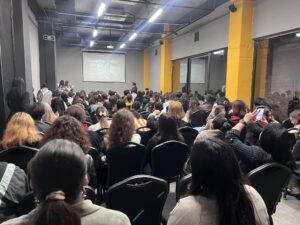
On 22 November 2025, Terminal Abashidze in Tbilisi transformed into a vibrant meeting point between Georgia and Korea. The event, Korea Day, organized by the International Mind Education Institute (IMEI/GMEI), invited 100 lucky guests to enjoy Korean quizzes, taste kimbap, learn basic Korean expressions, and explore the deeper mindset behind Korea’s rapid development.
Joseph Park, one of the organizers, describes the Georgia–Korea relationship as “a partnership that is steadily deepening, built on mutual understanding and respect.” In recent years, cooperation between the two countries has expanded across trade, culture, education, and tourism. As he explains, “Georgia’s strategic location and Korea’s advanced technology make a natural synergy. We already see high-quality Georgian wine and agricultural products entering the Korean market, while Korean IT and infrastructure companies are joining development projects here.”
Tourism is also flourishing. After the pandemic, travel between the two countries grew dramatically. Many Koreans are discovering Georgia’s ancient history and natural beauty, while young Georgians—largely driven by K-pop, Korean drama, and animation—are placing Korea high on their “must-visit” lists. “This human exchange,” Park says, “is the strongest foundation for the friendship between our peoples.”
The fascination of Georgian youth with K-Culture is something Park sees not as a temporary trend, but as a potential force for meaningful cooperation. “The enthusiastic interest of young Georgians in K-Culture is more than just a passing trend; it is a powerful ‘Cultural Bridge’ connecting the future generations of both nations. Utilizing this energy in a constructive way is precisely the task for our generation.” He imagines a future where K-pop dance clubs evolve into innovation hubs, or workshops using Korean animation technology help young Georgian talents enter the global creative industry. “We must link this enthusiasm to education, vocational training, and the development of the startup ecosystem.,” he says.
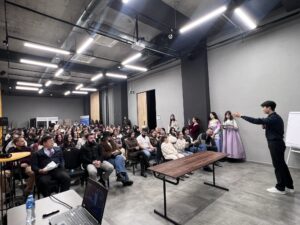
This philosophy is part of what inspired the creation of Korea Day. Park says the team traveled from Korea specifically for the Georgian audience. “There are many people here who love Korea,” he says. “We wanted to give them something deeper—not just the culture itself, but the Korean mindset that shaped it.”
The event will offer more than entertainment. Guests will experience Korean language lessons, kimbap making, K-pop elements, cultural quizzes, and a lecture on Korea’s development mindset—the inner framework that has guided the nation’s rapid rise. Park describes one of the most striking contrasts between the two cultures: Korea’s palli-palli (“hurry-hurry”) rhythm of efficiency and speed, compared with Georgia’s relaxed appreciation of the present moment. “Both have strengths,” he says. “Understanding these differences helps deepen mutual respect.”
At the heart of IMEI’s work is the belief that true change begins with the mind. Park compares the mind to a blueprint. “The shape of a building depends on its blueprint. In the same way, life changes depending on the mindset you hold. People try hard to change their surroundings or themselves without first shifting the heart. When the heart changes, life follows.” He explains that IMEI, a non-profit, exists to teach this “way of the heart,” offering programs that develop clarity, emotional stability, and personal transformation.
He also emphasizes how deeply the organization values Georgia. “We love this country,” he says simply. “Our events are created together with volunteers who also love Georgia. They give their time, their effort, and their heart. We are truly grateful for them.”

The growing warmth between Georgia and Korea has strong historical and economic foundations. Georgia’s strategic position at the crossroads of Europe and Asia—supported by pipelines, railways, and open economic policies—has long attracted international partnerships. Since 2017, Georgia has been building a closer relationship with Korea. This led to a cooperation agreement in 2019 to boost trade, tourism, and industry. Soon after, direct flights between Tbilisi and Seoul began, enabling easier travel and stronger people-to-people ties. The diplomatic motto, “More Korea in Georgia, and More Georgia in Korea,” continues to resonate.
Korea Day is a small but meaningful step in this larger narrative—a celebration not just of culture, but of connection, curiosity, and shared values. As Park says, “This event is for the Georgian people who love Korea. We hope they will feel the heart behind the culture, and discover something new about themselves, too.”