
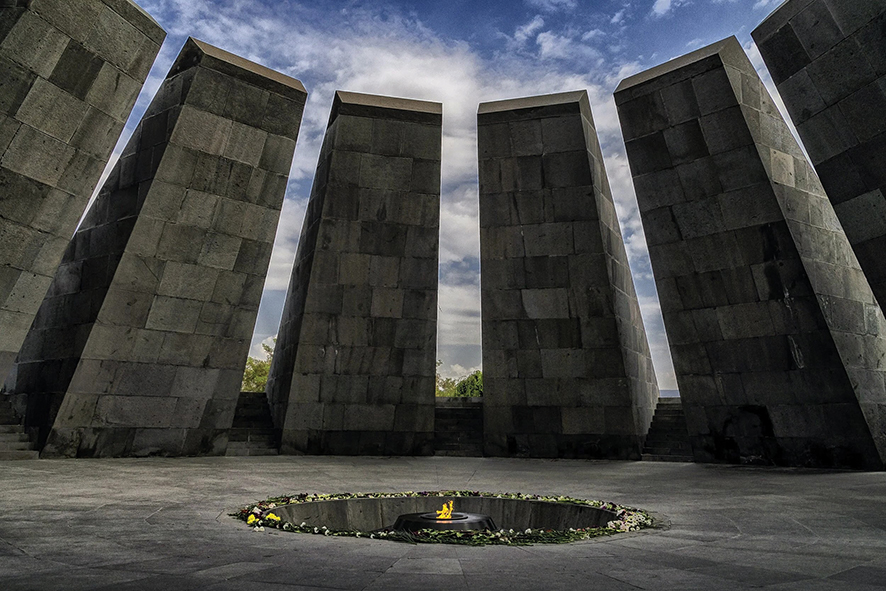
Israel’s government has unanimously approved a resolution to formally recognize the Armenian Genocide, marking a historic shift in the country’s long-standing policy and triggering strong criticism from both Türkiye and Azerbaijan.
The resolution, initiated by Israeli Foreign Minister Gideon Sa’ar, was approved by the Cabinet this week and will now be submitted to the Knesset for debate and a vote before becoming official state policy.
Following the decision, Sa’ar thanked Prime Minister Benjamin Netanyahu for supporting the initiative and praised government ministers for their unanimous backing.
“It’s never too late to do the right thing. I thank Israeli Prime Minister Netanyahu for his support, and the government ministers for their unanimous approval of the resolution I initiated for Israel’s recognition of the Armenian Genocide,” Sa’ar wrote on X.
He said Israel had joined dozens of other countries in officially recognizing the Armenian Genocide, describing the move as the fulfillment of a “moral duty” and a rejection of efforts to deny the historical events.
For decades, successive Israeli governments avoided formally recognizing the Armenian Genocide, largely out of concern for preserving relations with Türkiye. However, relations between the two countries have deteriorated significantly in recent years, particularly amid the war in Gaza, paving the way for the policy change.
Historians estimate that up to 1.5 million Armenians were killed by the Ottoman Empire during and after World War I, in what is widely regarded by scholars as the first genocide of the twentieth century. Türkiye rejects the term “genocide,” maintaining that the deaths occurred amid war and civil unrest, and disputes both the death toll and claims of systematic extermination.
Türkiye condemned Israel’s decision, accusing it of being politically motivated and intended to divert attention from the war in Gaza.
In a statement, the Turkish Foreign Ministry said the resolution was a “malicious attempt” that ignored legal and historical facts and reflected pressure on Prime Minister Benjamin Netanyahu and other Israeli officials facing arrest warrants issued by the International Criminal Court.
The ministry added that Türkiye would continue working to end what it described as Israel’s expansionist and destabilizing policies in the region while seeking accountability for alleged crimes committed against civilians, particularly Palestinians.
President Recep Tayyip Erdogan also rejected Israel’s decision, responding after a Cabinet meeting.
“We do not give the slightest heed to the slanders about our country from the murder network that has the blood of 73,000 innocent Gazans, most of them children and women, on its hands,” Erdogan said. “In our history there is no genocide, no massacre, no oppression, and no colonialism.”
Azerbaijan likewise criticized the Israeli government’s decision, describing it as “a cause for serious concern.”
In a statement, Azerbaijan’s Ministry of Foreign Affairs said it was unacceptable to distort the historical facts surrounding the events of 1915 and to reduce what it called a complex historical issue to a political decision “without a solid legal or scientific basis.”
“Such actions do not contribute to reconciliation and mutual understanding. On the contrary, they undermine efforts to achieve lasting peace and stability in the region,” the ministry said.
Baku called on the Israeli government to reconsider its decision and stressed that Azerbaijan “remains firmly committed to protecting historical truth, respecting the principles of international law, and promoting lasting peace and stability in the region.”
The recognition represents one of the most significant changes in Israeli foreign policy toward the issue. Once approved by the Knesset, Israel will formally join more than thirty countries, including the United States, Canada, France, Greece, the Netherlands, and Russia, that officially recognize the Armenian Genocide.
By Team GT









