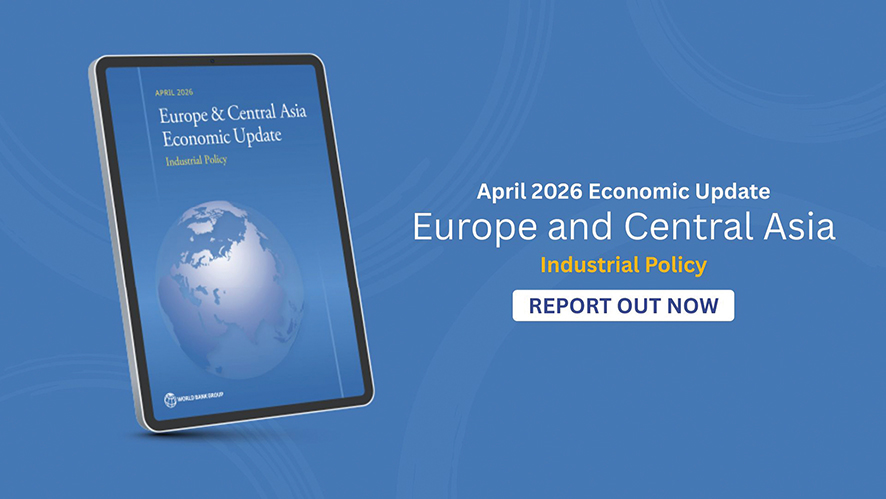
Economic growth across developing countries in Europe and Central Asia (ECA) is set to slow markedly this year, as mounting geopolitical tensions, trade fragmentation, and the ongoing conflict in the Middle East weigh on the regional outlook, according to the latest ECA Economic Update released by the World Bank Group.
The report projects regional growth to weaken to 2.1 percent in 2026. In Russia, growth is expected to decelerate to 0.8 percent, while expansion in the rest of the region is forecast to ease to 2.9 percent, as higher energy costs curb consumption and uncertainty dampens investment.
“The region’s resilience continues to be tested, with several countries dependent on imports of natural gas, oil, and fertilizers,” said Antonella Bassani, Vice President for Europe and Central Asia at the World Bank. “Efforts to address the impact of the crisis will be needed in many countries, with a focus on targeted measures to protect the most vulnerable. Pressing ahead with policy reforms for firm growth and job creation will also help to mitigate crisis impacts and strengthen economic resilience and dynamism.”
Subregional trends point to a broad-based slowdown. Growth in Central Asia is expected to average 4.9 percent in 2026 and 2027, reflecting stabilizing oil production in Kazakhstan. In Central Europe, growth is projected at about 2.4 percent this year before moderating slightly to 2.3 percent in 2027, with weaker consumption partly offset by European Union funded public investment. The Western Balkans are expected to see growth averaging 3.1 percent over the next two years, supported by infrastructure investment and strong service exports.
Ukraine’s economy is projected to expand by just 1.2 percent this year, constrained by ongoing hostilities, rising energy costs, and mounting fiscal pressures.
The report highlights a prolonged and intensifying conflict in the Middle East as a key downside risk. Such a scenario could significantly disrupt global supplies of energy and fertilizers, driving up energy and food prices and further dampening growth across the region.
Beyond immediate risks, the report underscores a longer-term challenge in the form of slowing productivity growth across many ECA economies over the past decade. In response, some governments have increasingly turned to industrial policies, which are targeted interventions aimed at promoting specific sectors, activities, or firms.
A special analysis in the report suggests that these policies would benefit from clearer targeting and a stronger focus on future competitiveness rather than reinforcing existing economic weaknesses. Currently, nearly two-thirds of industrial policy measures are concentrated in agriculture and food production, while only 10 percent are directed toward high-tech or capital goods sectors.
“To achieve stronger growth in productivity and jobs, ECA countries could prioritize ambitious policy reforms that modernize the business environment, catalyze entrepreneurship, and improve the quality of education,” said Ivailo Izvorski, Chief Economist for Europe and Central Asia at the World Bank Group.
“Tailored public inputs, such as industrial parks or special economic zones, are the most important type of industrial policies that can help address well-identified market failures. But industrial policies have to be used sparingly and only temporarily.”
The report concludes that where industrial policy is applied, it should support new and dynamic private sector firms and ideas, rather than protect incumbents such as state owned enterprises, and must reinforce rather than undermine market competition.