Georgia is blessed with four distinct seasons, and now we are sliding from a warm, dry autumn towards winter. Some of the mountain areas, such as Tusheti and Khevsureti, are already closed, their high-altitude passes snow-covered. By now, the annual migrations of people and sheep south from those provinces has happened, leaving just a handful of hardy souls in each. Ushguli in Svaneti has its main road in from Mestia kept open, but the other, much higher one in and out (2800m), down to Lentekhi and Kutaisi, is also closed, getting too much snow to keep clear.
Proper winter tires, with a snowflake mark on them, become required by law for travel on other mountain roads, such as to the main ski resorts of Bakuriani and Gudauri. Check for details before setting off, for your own safety.
Meanwhile, in the much warmer lowlands, the winter is much milder, with usually just a sprinkle of snow lasting a few days at a time. Indeed, wintering away from Svaneti for the fourth time in Tbilisi with my wife, I wait for just a few degrees below freezing to bring me ice to photograph. It’s all I will get.
Falling leaves here in the capital and nearby give me a photographic challenge to try. Instead of many quickly shot frames and stacked of birds’ flight patterns, I want to try tracking the leaves in a similar way. Tripod-mounted to keep the still trees themselves in place from frame to frame, my shots will show the progress of each leaf as it descends, over fractions of a second. I have these images in my mind’s eye; now I just need to wait in readiness for the right conditions, then go and give it a try. At least digital photography lets me see the results instantly, and adjust my camera settings as necessary for the next batch of shots.
I have made it a habit to return to Svaneti in late winter for the annual Lamproba festival of burning torches. But last time, February 2025, the road back down was much more hair-raising than usual, with many avalanches, rockfalls and tree-falls to slow us down dramatically. This time exiting, in late October, that road towards Zugdidi is in such a poor state, pre-winter, that I’m for the first time quailing about making the journey up and down in deep snow. There are many places where half of the width of the road has fallen away, or places where frost heave has made a mess of the rebar-reinforced concrete road surface. These await attention, or the whole thing will simply continue to worsen.

Skiing and other winter sports remain popular in Georgia; the above-mentioned two areas are close enough to Tbilisi for day trips. Upper Svaneti’s two resorts, above Mestia and between Mulakhi and Ipari, and much further away from the capital, needing more time commitment, usually opening in late December. But they do also offer spectacular heights and run lengths, particularly the latter one, Tetnuldi, giving 2.3 km of altitude and the longest run in the Caucasus. I never learned downhill skiing in Canada, as it was rather expensive; Georgia’s winter sports scene is comparatively so much cheaper than in North America or Europe.
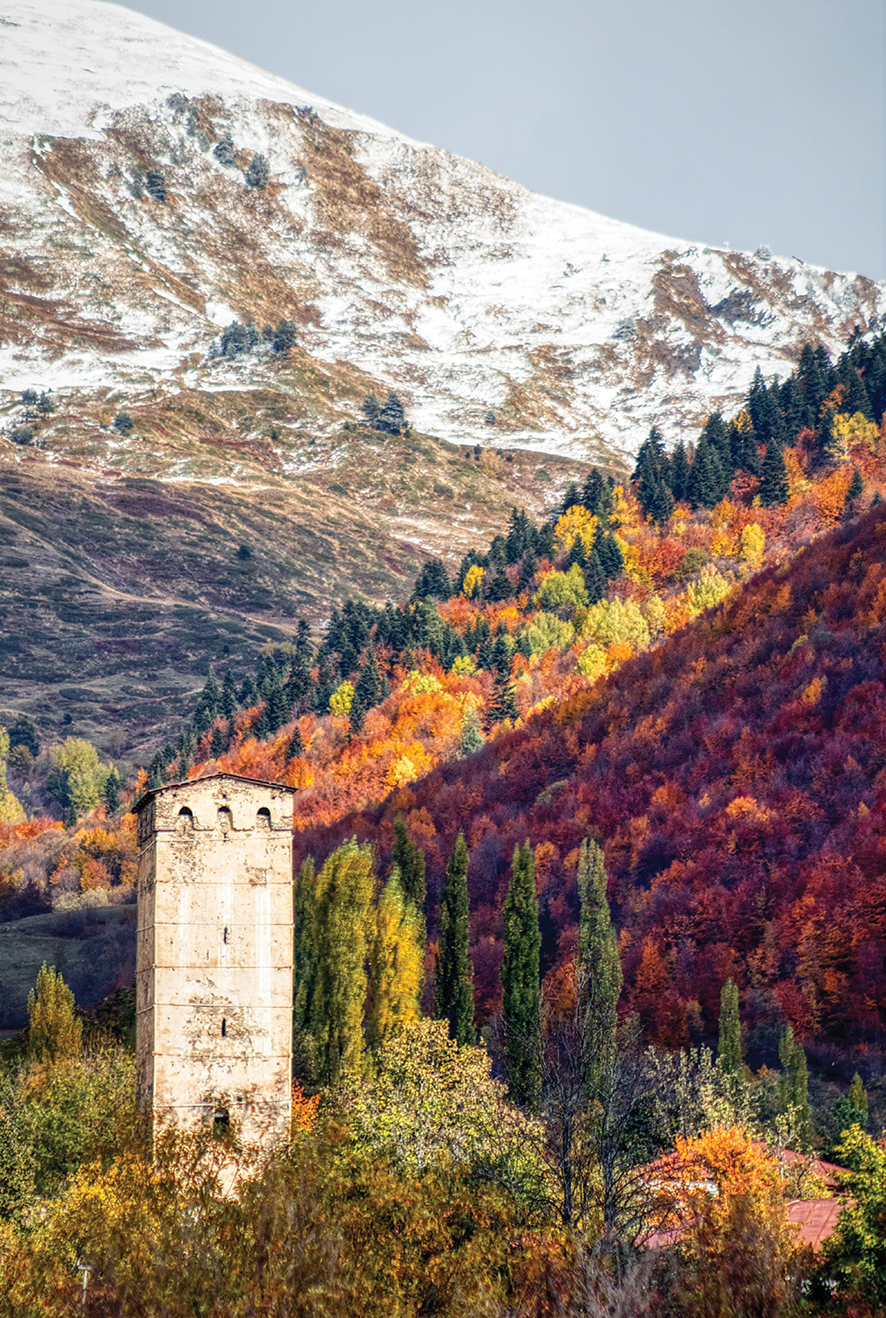
The simple beauty of autumn mountain foliage, all warm colors mixed with the evergreens, and a layer of snow on its top half, is dazzling. Eventually all those leaves will fall, and the scenes will turn almost monochrome under much more snow. Indeed, I usually process my photos from these times to simple black and white, as there is so little color in them anyway. But whether it’s huge vistas or tiny details a few mm in size, the change of seasons offers something new for every eye.
Newly fallen snow, or even snow still falling, has a soft, mostly smooth texture under low-contrast cloudy skies. But side-lighting by the low winter sun brings out its rich textures. Then, later, wind will sculpt it into grand, fractal textures, and the whole view becomes something else. There is so much variety in what snow can become that I feel no surprise at Inuit languages’ legendary several hundred words for it. 15 winters in Svaneti have taught me the truth of this.
Ice, too, has an infinite variety of shapes and surfaces to offer, depending on its thickness, the temperatures of its forming and weathering, moisture, and more. It’s really worth noticing these small details, which are on display every winter in Georgia, at any altitude at least for a short time. If you’re not into the winter sports, a simple stroll into the snow and ice (properly protected from the cold) will show you what is available if you take the time to notice.

Wintering in Dighomi on the edge of Tbilisi, I see the small rush-edged ponds and puddles here ice over just for a short while in the new year. The puddles’ ice, sometimes less than 1 mm thick, might entirely melt on sunny days, so I have to go out first thing in the mornings. But their appearance utterly changes at these times, and even more so if snow comes. There is nothing like a walk through the neighborhood at these times to remind one how fantastic water is when it freezes, how limitless in form. For now, I wait, but not impatiently, as each day and season has its own beauty. There might be similar opportunities in any of Tbilisi’s many parks; or just outside the city, back in more nature. If you suffer from winter blues, this is one solution to bring back wonder. Dress well, take a phone or camera or just your sight, and allow the season to astonish you.
Green will return, in spring. For now, late autumn and winter are what await us, and there’s no point in wishing them away. Embracing them with all they offer will bring joy and wonder at the variety of the world. These are not dying or dead seasons; they are full of new life. Enjoy, wherever you are or go.
Blog by Tony Hanmer
Tony Hanmer has lived in Georgia since 1999, in Svaneti since 2007, and been a weekly writer and photographer for GT since early 2011. He runs the “Svaneti Renaissance” Facebook group, now with over 2000 members, at www.facebook.com/groups/SvanetiRenaissance/
He and his wife also run their own guest house in Etseri: www.facebook.com/hanmer.house.svaneti