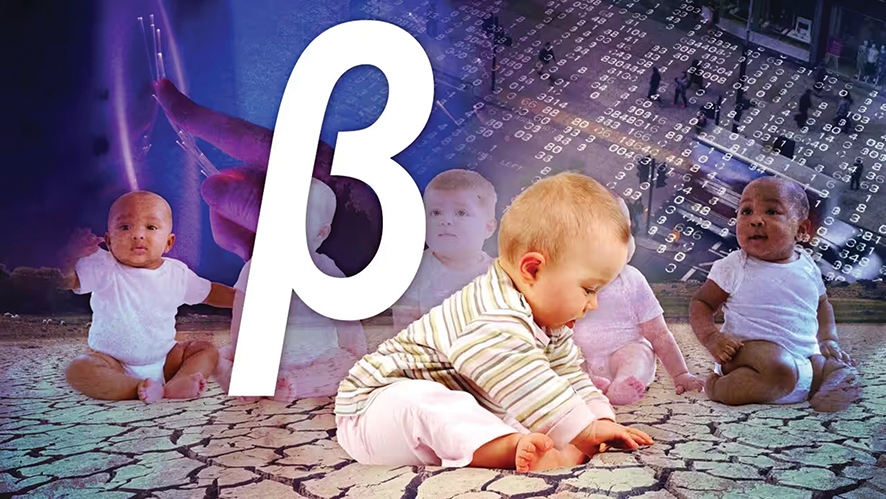
I am not quite sure if the name Mark McCrindle might ring all the bells in the world, but the guy is a fairly well-known social analyst, futurist, and demographer, trailing the most noticeable issues that occur in our weird times and all kinds of social trends that have an impact on our overstrained modern lives. It was he who, in the complicated and strenuous process of meticulous insights and profound analysis, baptized two generational cohorts, Alpha and Beta, although the terms are not fully recognized demographic phenomena like Gen Z or Millennial. Anyway, the Alphas were the subject of our recent piece. This time, the Betas will be the subject of our focus.
I encounter a lot of Alpha kids in my academic and social life in this country and, frankly, they make me think twice before I tell them anything that seems to me useful and wise to utter. Indeed, you don’t want to mess with them, because their seemingly childish minds are like a steel trap, and their behavior impresses with unbelievable precociousness. Our Alphas speak their own kind of Georgian, and they pick up foreign languages at a moment’s notice.
The Betas that are coming into life right now (they are and will supposedly be born between 2025 and 2039) are named after the second letter of the Greek alphabet and are thought to be the children of younger Millennials and Gen Z. The name has instigated controversy and criticism from some of the means of mass communication, because the appellation “Beta” was taken as an insult, meaning someone who is weak or passive. Some suggest that another, more descriptive name might fit when time passes. This way or that way, professionals of the planet keep arguing about the name, character, and birth time frame of the generational cohort that will be sure to start making an immense difference before we know it.
Social generations characteristically span roughly fifteen years, and are shaped by major societal shifts and numerous expected and unexpected vicissitudes of life. If we believe what McCrindle is predicting, Generation Beta is going to be impacted by diminishing birth rates, and will probably make up around 16% of the world’s population by the year 2035. The same prediction purports that Gen Beta is to reach 2.1 billion people, surpassing Gen Alpha’s two-billion presumption. It is also suggested that Gen Beta will have a stronger appreciation for diversity than previous generations, and, certainly, it is expected that many members of Gen Beta will live to see the 22nd century.
And here is why these thoughts should make sense for this nation’s future and its successful spiritual stability, as well as its social well-being, demographic boost, and economic prosperity. None of this will happen to us unless Sakartvelo’s upcoming Gen Beta is in step with the rest of the world in terms of exceeding in numbers the previous generational cohorts. This must happen in Georgia. Must!
The prerequisites for this wistful thinking seem to be in place in this land: more and more married couples are picking up the courage to have over two kids, opportunities to provide for sustenance seem to be increasing, our children are adapting to modern technology with smarts and vigor, fearlessly immersing themselves in scientific novelties, thus creating the prerequisites for further national development; and on top of all that, their integration with the opportunities suggested by artificial intelligence is becoming firmer. The Georgian Gen Beta personalities will be more dynamic and adaptable than their predecessors, which allows for significant changes in roles, beliefs, and self-perception, based on experience, social interaction, readiness for personal growth, and not being enslaved to stiff definitions.
This kind of social prospect might be predicated on the premise that the freedom-loving Georgian nation is well-oriented in the notions, moods, and quirks of our contemporary life, and finally will find the way out of the current national quandaries. That’s going to be the main function of Georgia’s Gen Beta, which will soon be in tangible making. Those kids of the future will not have time or desire for stupid controversies, senseless polarization, ridiculous political recriminations, irrational media discussions, and meaningless disputes on social media: they will know what to do, and how to push the nation towards a guaranteed good life. The never-going-away overwhelming rhetorical question in Sakartvelo – Is there a way out? – can only be answered by means of focusing on national-level decisive issues. Nobody will do this except Georgia’s Gen Beta, whose maturation for the great struggle is not too far away.
Blog by Nugzar B. Ruhadze