
Nothing is plain and trivial in Sakartvelo, and on top of that peculiarity of our life in this land, we usually celebrate Christmas and the New Year twice. Not once, as the rest of the civilized world does, but twice! And the reason for that uniqueness of our social behavior should be the fact that we want to be a part of both worlds—the new, modern Western and the old, traditional Eastern—which is not bad in principle. This might even be geopolitically winsome, because the fact of natural belonging to both worlds gives us a better chance of survival and prosperity. Oh, I didn’t mean to be carried away with political scrutiny of the season, but, you know, in our politically overcharged time, one is always tickled with a bizarre penchant to politicize every bit of human existence.
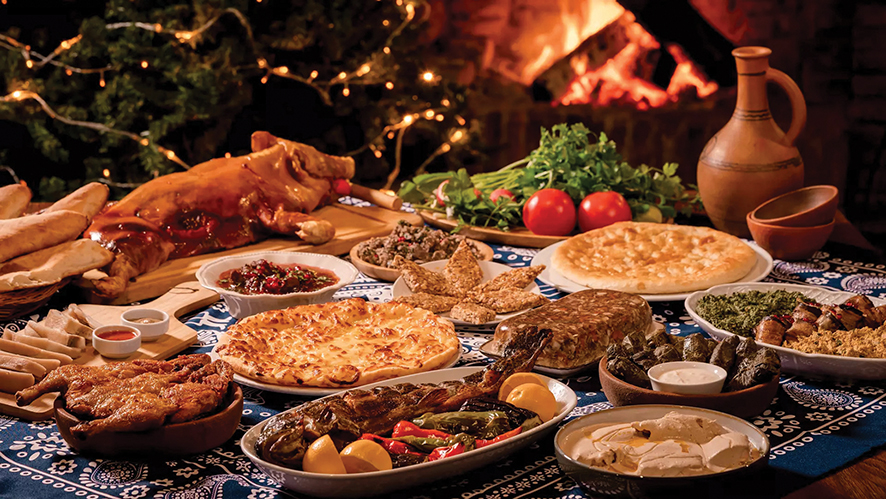
Going back to our post–New Year feelings and stance, Georgia is branded as a place of a protracted celebratory and jovial atmosphere, within which the focus is concentrated on family cohesion and togetherness, all of us being adamant about seeing the New Year in at home, in the company of our immediate family members, and then, if necessary, going out and having fun in a different company—better or worse—of others. The fête that lasts for several (no exaggeration!) weeks will culminate in Orthodox Christmas and the so-called Old New Year—toasts, hugs, kisses, smiles, open hearts, overloaded festive tables, glittering streets, rifle shots, fireworks, and cracker sounds all over the place again! Kill me if you want, but I will never say, even at gunpoint, whether this is good or bad. Not my business to be judgmental in the days of national felicity! This is what tradition is asking of us, and we all go for it pleasurably and with a genuine sense of gratification.
We will never go for a single-day event. The excitement will extend well into January, with cities remaining decorated until around the 15th of the month. Here are the calendrical events that follow: Bedoba—the 2nd of January—known as the Day of Fate, which is well thought out as something exceedingly imperative. Georgians believe that the events and mood experienced on Bedoba set the tone for the entire year, so people strive to be happy, peaceful, and surrounded by loved ones. It is a day for joy, eating sweets, and general positivity. In a word, what you do or the way you behave that day will brand the entire prospective year. To put it in simpler language, Bedoba is the day that determines our fate, when we want to be very careful, correct, and right, so that our correctness and righteousness stick for the rest of the year and determine whatever success is in store for us in the just-starting new year.
The next important day on the calendar is Orthodox Christmas—January the 7th—a religious holiday when believers attend church services and light candles. The day is also marked by the large public charity procession called Alilo, where participants parade through the streets collecting donations for those in need. The third and last significant date, following New Year’s Day, is the so-called Old New Year—January 14—celebrated according to the Julian calendar. This day offers one last chance for families to gather, exchange good wishes, and enjoy traditional foods and drinks before the holiday season fully concludes.
That said, judging by cultural disposition and the accompanying atmosphere, the general mawkishness develops into a ubiquitous feeling, and the post–New Year sentiment—warmth, hope, and devotedness—becomes overwhelming. And last but not least, a core Georgian value—hospitality—is elevated to the acme during this time, with guests being treated as gifts from God, and with a strong emphasis on strengthening family bonds over abundant feasts—the supras—that are embellished with toasts and endless kudos and sincere benevolence for each other. There is a collective feeling of optimism and a longing for rekindling, with heartfelt wishes for health, happiness, and prosperity in the coming year.
The exceptional tradition of the Mekvle, the first person to cross a home’s threshold after midnight, adds a coating of hopeful anticipation, as a well-chosen visitor is believed to bring good fortune. In essence, the moods in Georgia in post–New Year time are far from a sudden standstill after celebrations. Rather, they are a sustained embrace of joy, tradition, and shared hope for a sweet and prosperous year. In a word, it feels so good that traditionalism is not dying in this blessed, gorgeous land called Sakartvelo, and that eternal hope is sparkling as a sure token that life is wonderful, no matter what.
Blog by Nugzar B. Ruhadze