When NATO does not respond to this kind of threat, NATO as we know it effectively stops existing, – says Polish security analyst Bartłomiej Kot in an interview with RFE/RL’s Georgian service.
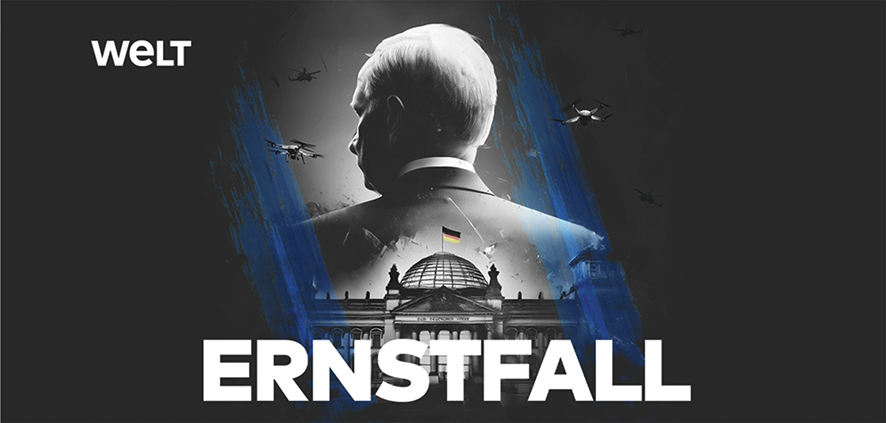
His remark follows a widely discussed wargame organized by Die Welt together with the German Wargaming Center at Helmut-Schmidt University in Hamburg, which simulated a Russian move against Lithuania in 2026 under the cover of a fabricated humanitarian crisis in Kaliningrad. The scenario: Russia enters Lithuania under the pretext of a humanitarian crisis in Kaliningrad and occupies the strategically important city of Marijampole. It ended with allied hesitation, no immediate Article 5 response, and Moscow successfully presenting the Alliance with a fait accompli.
The exercise, later dissected by international media, including The Wall Street Journal, was designed primarily to test political decision-making in Berlin rather than battlefield tactics.
Kot, who in the simulation played the role of Poland’s prime minister, argues that the real lesson is how easily hybrid pressure could fracture allied unity before NATO even reaches the stage of a conventional fight.
What were the principal takeaways from Die Welt’s wargaming exercise?
An important thing to remember while discussing the wargame is that, first and foremost, it was a political exercise, designed to test the readiness and leadership of the German side. In a more military-focused wargame, NATO would have had to become involved much earlier through some form of automatic response, just as happened recently when Russian drones appeared in Polish airspace.
Talking about the results, I must say that, unfortunately, our German colleagues were very hesitant regarding escalatory action, not only in terms of activity but even rhetoric, toward Russia. The primary instinct observed during the game was to de-escalate from the very beginning all the way through to the end. Responding actively in a conventional way to a hybrid threat from Russia seems not to be an easy scenario to follow. Whenever Russian activity shifted from hybrid to conventional, the German response was always quite reactive militarily, with much more focus placed on domestic social resilience. At least, that is what this wargame demonstrated.
What was particularly surprising was the limited understanding displayed regarding the breach of sovereignty of a NATO member state. The very Russian claim of effectively closing the skies over Lithuanian territory, even under the pretext of a humanitarian crisis, was, in my opinion, enough to constitute a violation of a NATO member’s sovereignty, even without conventional action on the ground. I was trying to convince the others of this.
At least in the first 48 hours of the wargame, the US was not prepared to intervene militarily or launch airstrikes. Why? How plausible is that in real life?
This was the hybrid element: the Russian claim that they were merely creating a humanitarian corridor before entering Lithuania. Much of the initial American decision-making was therefore based not on Russian troops already being present in Lithuania, but on Moscow’s assertion that it intended to create such a corridor. The conclusion was: we should not invoke Article 5.
What was specific to the American position was that they also tried to bilateralize the response. They said: “Okay, you can consult among yourselves and discuss whether this is Article 5 or not. We believe it is not, and we will try to resolve the crisis by talking directly to Russia.” In my opinion, this aspect is even more important than the entire controversy the wargame caused in Germany.
NATO would never allow itself to become pinned down in trench warfare. It would be a war of the skies above all
Let me be clear: the idea that this wargame tested the allied response is not entirely accurate. It primarily tested the political decisiveness of German politicians, simply put. There was no one playing Lithuania, which obviously would have had a say. There was no one playing France or the UK. The international contributors were only dialed in. That, of course, limits the possibility to react on a moment-to-moment basis and creates a situation of reactiveness to the German players.
Which would not have been the case in real life.
Of course not. At some point, I decided on a more proactive approach. I said: let’s test the Russians. I suggested testing them over this claimed humanitarian corridor by sending a humanitarian convoy of our own through it, protected by NATO troops.
It was a simple move: we were mirroring the Russians. If they reacted militarily to NATO troops’ presence in the sovereign airspace of an Alliance member, they would be responsible for the escalation. If they did not, then it would mean they do not, in fact, control Lithuanian airspace, which also means the political narrative they are constructing for propaganda purposes, that they have closed the skies, is simply not true.
I suspect your idea was not taken on board.
It sparked interest from our German colleagues and willingness to use the capabilities of the German brigade already stationed in Lithuania. But, after discussions with the US Secretary of State, it became clear we would not be able to act fast under the NATO banner. So I said: fine, let’s do it under a coalition-of-the-willing flag.
As Polish prime minister, I would contribute to that movement of troops. I could provide air assets. But I would like to know whether the French and British would join.

The article in Die Welt says Poland mobilized, unlike Germany, but did not intervene. Why not?
Because I was never put in a position where I could actually react in such a manner. The scenario simply never expanded to the point where it was time for the Polish PM to make a decision on an intervention once the Russians already had boots on the ground. That was my main gripe with how the wargame was constructed.
That doesn’t sound like a very fleshed-out wargame; not giving the parties involved equal opportunity to react.
The entire gameplay, the whole engine of the exercise, was designed to test the Germans and their response to Russian narratives. This is understandable for the German newspaper, but it certainly displays flaws in terms of the realism of the scenario.
Let’s try to fill the gaps then. Imagine an add-on where you get the chance to react. What does Poland do?
I would say the first priority would be to seize leadership. Once we see that the Germans or other Western allies are not responding to the threat, we would have to mobilize and react conventionally.
If some allies are unwilling to enact Article 5, this would not be done under the NATO flag, so we would intend to form the coalition of the willing.
If I decided to intervene, before actually doing anything I would try to build such a coalition: probably us, the British, the Scandinavian countries, maybe Romania.
How much time would that have taken? Wouldn’t you just be faced with Russians already entrenched in Marijampole?
This is not a decision that takes days. It has to be made within hours. If NATO does not decide, we could enact the plans already developed within NATO, but on behalf of the coalition of the willing, because we know how to act.
So if Russia’s main objective is to damage and undermine NATO’s credibility, then they succeed, because it is the coalition of the willing that responds, not NATO.
When NATO does not respond to this kind of threat, as displayed in the scenario, NATO as we know it effectively stops existing, in my opinion. But to return to the potential Polish response: if Russian troops appeared in Lithuania, there would be an automatic response from Poland: to react, not to wait.
Experts warn this could happen soon. How significant is the combat-experience gap between battle-hardened Russian troops and relatively inexperienced Lithuanian and German forces?
That’s a question of timing, isn’t it? It’s all about when such a scenario would unfold. If we were playing it out right now, certainly there would be a cognitive difference between the sides: one is very much in a wartime mindset, the other is not.
But it also depends on what the situation in Ukraine looks like at that moment. On a daily basis, NATO is learning from Ukraine how to conduct this new type of warfare.
The wargame assumes this scenario would only unfold after a ceasefire in Ukraine. Was there any explanation of how the Ukraine war ended within the framework of the exercise?
Basically, the initial scenario says that Russian troops eventually captured the entire Donbas region. Another migration wave from Ukraine to the West occurs, and then a ceasefire appears. Russian and Ukrainian negotiators agree to freeze the front line. Kyiv does not recognize the occupied territories.
Does Kyiv proclaim neutrality? Meaning it would not get involved in this scenario either?
It doesn’t say that. A contingent of troops from the Global South monitors the line of contact. There is a French-British battalion in western Ukraine. Nothing larger than that.
So it would be in Russia’s interest to act as quickly as possible once the ceasefire in Ukraine is in place, before you manage to catch up.
Certainly. But it also depends on how far Russia is willing to test and risk things. I believe that, on a conventional level, Europeans today possess the capability not only to win a war with Russia, but also to deter.
Really? Even in terms of unmanned warfare?
Yes. I do not believe a war between NATO and Russia would look exactly like what we are seeing now in Ukraine. NATO would never allow itself to become pinned down in trench warfare. It would be a war of the skies above all.
There would never be a situation like the one we see today in Ukraine. The issue with this scenario is that hesitation on NATO’s side in responding to hybrid threats from Russia undermines NATO solidarity and, in fact, the very core of NATO.
What this scenario showed, and that is certainly a lesson learned, is that Russia can undermine NATO solidarity by acting in a hybrid manner. It can weaken the alliance before even testing it conventionally.
When you speak about a coalition of the willing in such a scenario, who do you actually envisage being part of it, and how willing would they be to get involved?
There is obviously a lot of uncertainty and speculation, but if I were to name a few, it would be those countries that already have a stake in the game: Finland, Sweden, the United Kingdom, possibly Norway, Denmark, Romania.
And when we talk about willingness, what level are we talking about? Boots on the ground?
In the case of Finland, Sweden, and the UK, I would assume boots on the ground. Plus Poland, of course.
What I am trying to say is this: I do not believe in a scenario in which the situation in Lithuania is so isolated that it provokes no response from any ally. It might not be all of them. It might not include the United States. It might be a European response. But, in my opinion, there would always be at least some allies deciding to act from the very beginning.
It would not be bloodless.
Interview by Vazha Tavberidze