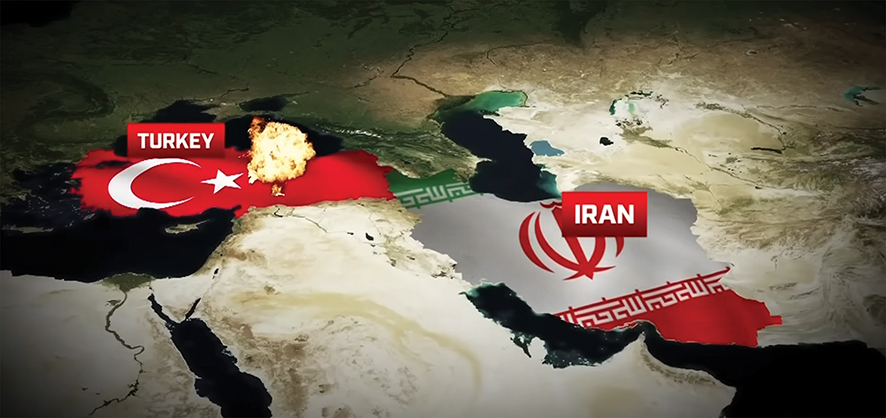
The deepening crisis in Iran, with its potential for spillover, might radically reshape the South Caucasus, shifting the region from a peripheral observer to a primary front line. While Armenia, Azerbaijan, and Georgia have decades of experience navigating a delicate relationship with Tehran, the current hostilities threaten to demolish the previously existing balance, replacing it with immediate security threats, economic stagnation, and a disrupted regional status quo.
Developments in the wider region stipulate that the war is no longer a distant concern for the countries of the South Caucasus region. The early March 2026 strike on Azerbaijan’s Nakhchivan exclave signaled that the South Caucasus, not only theoretically but factually, is now, militarily speaking, firmly within kinetic reach. This spillover has triggered a rapid military buildup, with Azerbaijan and Turkey closing borders with Iran as an immediate reaction and bolstering defenses against potential drone and ballistic missile incursions.
Beyond accidental strikes, there is growing concern that vital regional transit and energy infrastructure, specifically the Baku-Tbilisi-Ceyhan pipeline, could be targeted by Iran as leverage against Western-aligned interests. Furthermore, the region grapples with an impending humanitarian crisis. A prolonged military confrontation poses a significant risk of triggering a massive influx of refugees northward, which could potentially destabilize the countries of the region, which are already grappling with internal social challenges, particularly Azerbaijan and Armenia, which share common borders with Iran, with Georgia being second in a row.
The war has effectively severed critical trade and energy corridors globally. Armenia is particularly exposed, as it historically relies on Iranian transit for nearly a third of its external trade. The sudden closure of these routes has caused immediate supply chain disruption, prompting a full switch to the only existing logistics alternative, relying on transit through Georgia. Regionally speaking, disruption and uncertainties related to the International North-South Transport Corridor (INSTC) have accelerated a shift toward the
“Middle Corridor” via Georgia and Azerbaijan as the safest route that keeps functioning, providing multimodal logistics services for the South Caucasus, Central Asia, and beyond. While this in turn may offer long-term advantages for the transit states, the short-term reality is defined by surging energy costs, high shipping premiums, and a possible sharp decline in foreign investment and tourism.
Geopolitically speaking, the South Caucasus is undergoing a fundamental restructuring as traditional pillars of the regional security architecture simply disintegrate under the weight of the current global changes we witness. This transformation is defined by the systemic collapse of Russia’s influence and, since the beginning of the strikes, a volatile shift in Iran’s strategic posture, forcing Armenia, Azerbaijan, and Georgia to navigate a high-stakes power vacuum established in the region that somehow tends to be integrated into a broader global standoff. It is clear that the era of Russian influence, as we used to know and experience it for decades, is effectively nearing the end.
Preoccupied by the war in Ukraine, Moscow’s role as the regional arbiter has shifted from dominant power to a sidelined observer, dismantling old deterrents that existed in the region. Simultaneously, the current war in Iran has pushed it toward transitioning its role toward the South Caucasus from a predictable buffer into a transformative wildcard, with a high degree of uncertainty in the near future.
Currently operating under a “nothing-to-lose” survival mode, Tehran’s posture has shifted from cautious diplomacy to aggressive military signaling. Georgia finds itself in a precarious position amidst this shifting landscape. Tbilisi, traditionally pro-Western, has experienced a shift in its internal political dynamics, leading to new domestic divisions. This shift has resulted in more transactional relationships with foreign powers. As Armenia aligns itself with European security frameworks and Azerbaijan solidifies its Turkish-Israeli alliance, the region has emerged as a primary battleground where Middle Eastern and European interests converge. Thus, any miscalculation on the regional level could potentially trigger international escalation.
Analysis by George Katcharava*
*George Katcharava is the founder of Eurasia Analyst, a geopolitical risk, consulting and advisory firm.