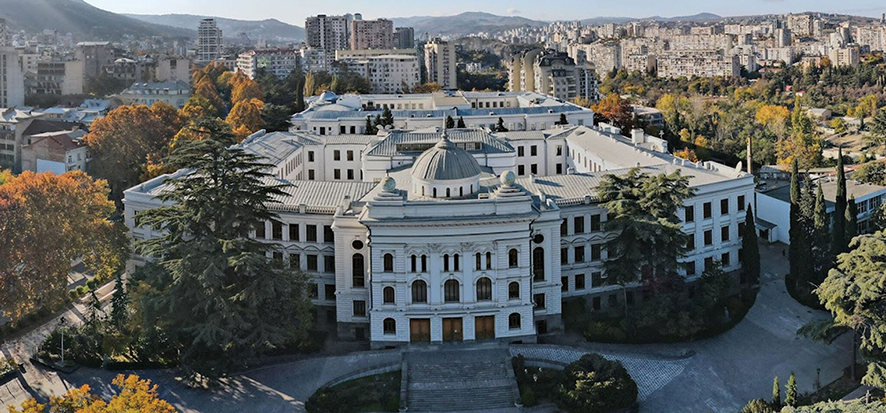
The Georgian government has reversed its decision to merge Ivane Javakhishvili Tbilisi State University (TSU) and Georgian Technical University (GTU), following widespread opposition from students, faculty, and academic councils at both institutions.
Prime Minister Irakli Kobakhidze announced the decision at a briefing held at the Government Administration, after meeting with GTU’s rector and professors. He confirmed that the two universities will no longer merge and said that, under the “one city – one faculty” principle, GTU will be transformed into a purely technical university.
“We have agreed that the Georgian Technical University and Tbilisi State University will no longer merge. In addition, within the framework of the ‘one city – one faculty’ principle, the Georgian Technical University will be transformed into a purely technical university. Accordingly, only those disciplines that were taught at the Technical University before the 1990s will be taught there in the future,” Kobakhidze said.
The Prime Minister also explained that, starting from the next academic year, admissions will no longer be announced for programs that were not part of GTU’s curriculum prior to the 1990s. Non-technical programs currently offered at GTU will continue under an interim regime for the next two years.
The government’s original decision to merge TSU and GTU was announced on January 29 by Education Minister Givi Mikanadze, as part of a broader reform of Georgia’s higher education system. The plan included the creation of a temporary governing council to manage the merger process and the appointment of acting rectors and vice-rectors to oversee the reorganization. Government officials said the merger, based on comparative analysis of academic programs and international practices, would strengthen academic resources, reduce administrative overlap, and position TSU as a leading regional hub for education, research, and innovation.
“The launch of this important reform in the higher education system is grounded in comprehensive analysis, international experience, and the strategic interests of the country,” Mikanadze said. He added that the merger was intended to enhance Georgia’s academic and scientific capacity and improve TSU’s international standing. Legislative amendments to facilitate the merger were also being drafted, and the temporary governing council was expected to manage the transition until the integration was complete.
However, the announcement was met with immediate criticism. The TSU Senate issued a statement arguing that the proposed merger was neither substantiated nor appropriate, calling for the process to be paused and for meaningful dialogue with all stakeholders. Similarly, the GTU Academic Council adopted a unanimous resolution on February 5 opposing any restriction of university autonomy, including a merger without the full participation and consent of the university’s governing bodies. The council emphasized that decisions made without the involvement of the Academic Council, Senate, Student Self-Government, faculty and scientific councils, research institutes, and the Rectorate would violate the autonomy guaranteed by the Constitution of Georgia. While supporting broader higher education reforms, GTU stressed that it would not accept changes imposed without consultation and consent.
Student opposition also intensified. On February 2, TSU students staged a protest near the university’s main building while the Academic Council met behind closed doors to discuss the proposed merger. Protesters said they were denied entry by security, despite previous assurances from TSU Rector Jaba Samushia that a limited number of students would be allowed to attend. After the meeting concluded, several students were admitted to meet with the rector, while others continued to gather in the campus yard. Students from TSU and GTU coordinated their positions, expressing concerns about governance, academic freedom, potential staff reductions, and the lack of a clear public plan for integrating programs and faculties.
The Academic Council of GTU, one of Georgia’s leading engineering and technical institutions, reiterated its readiness to participate in detailed discussions about reforms, provided the process respects constitutional principles, academic freedom, and institutional self-governance. The council stressed that any reform should aim to strengthen the country’s established engineering school rather than undermine it.
Prime Minister Kobakhidze’s announcement signifies an important shift in the government’s higher education reform strategy. Instead of merging the two universities, GTU will now be restructured as a specialized technical institution, following consultations with its representatives and in response to mounting criticism from the academic community.
By Team GT