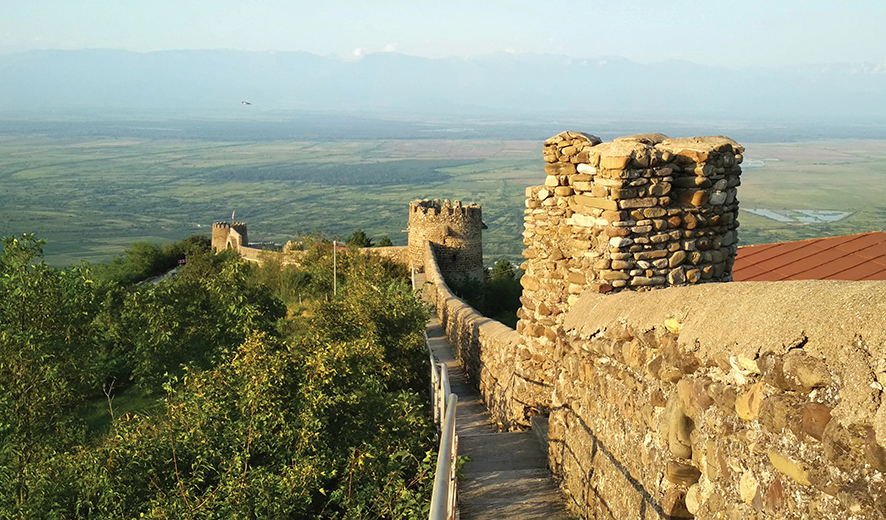
In the rolling countryside of eastern Georgia’s Signaghi municipality, where vineyards stretch toward the Greater Caucasus and the boundary with Azerbaijan winds along its gentle curves, the Alazani River is both lifeline and risk. Its waters sustain fertile fields, support local livelihoods, and quietly define the border between two nations. Yet, the river’s shifting banks pose a very real threat – to farmland, infrastructure, and even national security.
In January, Georgia’s Roads Department announced a series of four public tenders totaling GEL 9.205 million for riverbank reinforcement works along the Alazani. Officials describe these projects as essential not just to protect vulnerable land and infrastructure, but also to safeguard the border itself.
“The Alazani Riverbed serves as a natural border between Georgia and Azerbaijan, and therefore the planned works are of particular importance in terms of protecting the border area,” the Roads Department said in an official statement describing the tender process open to bidders through March. This is more than a civil engineering contract – it is a commitment to preserve both land and livelihood in a region where geography and geopolitics collide.
More Than Soil and Water: The Economic and Strategic Stakes
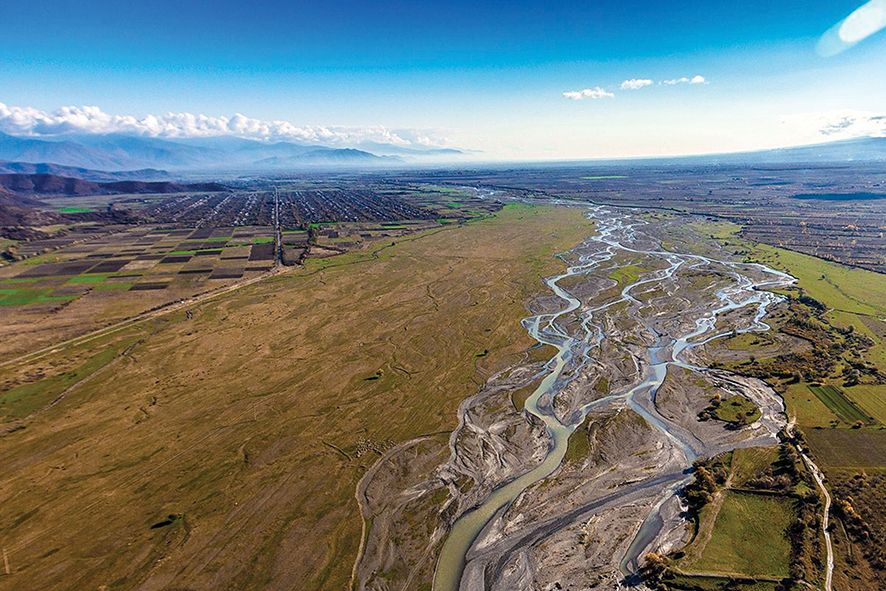
Stretching about 391 kilometers through the Caucasus, the Alazani – known as Ganikh in Azerbaijan – rises in Georgia’s mountains and winds southeast through fertile agricultural terrain before merging with the Kura River at Azerbaijan’s Mingachevir Reservoir. Along its course, it nourishes the Alazani Valley, a region famed for its vineyards and the heartland of Georgia’s wine industry. It irrigates fields, supports local ecosystems, and sustains communities whose lives are intimately tied to the river’s moods.
Part of the river forms the international border between Georgia and Azerbaijan, giving the engineering work a strategic significance beyond the typical infrastructure project. In recent years, the Alazani’s shifting banks have been a source of land loss and instability. Historical reports note that hundreds of hectares of Georgian farmland have, at times, emerged on the “wrong side” of the river after floods and erosion altered its course.
For Georgian agribusiness and exporters, this is more than a line on a map. The Alazani Valley is the backbone of the country’s wine industry and irrigated agriculture – a key contributor to export growth and rural employment. With tender submissions due in March, public and private sector bidders are now eyeing a share of the state-funded work alongside a cascade of infrastructure investments unfolding across Georgia.
Engineering Against Nature: A Growing Need for Resilience
The planned reinforcement projects will cover four sites across three districts in the Milari area and the village of Erisimedi. They are part of a broader effort to strengthen Georgia’s transport and hydrological infrastructure. The work will involve stabilizing riverbanks with revetments and retaining structures, measures that engineers say are crucial to prevent further erosion and protect nearby communities.
Beyond this initiative, the government has launched major tenders and contracts for roads and bridges across eastern and western Georgia, with hundreds of millions of lari allocated for transport improvements this year. But here along the Alazani, the stakes feel closer to home. Experts note that the river’s banks are especially vulnerable in flood-prone lower reaches, threatening farmland and local access roads. A joint environmental assessment emphasizes that bank erosion “needs immediate attention… to avoid or mitigate the further loss and degradation of hectares of agricultural land,” underscoring the critical nature of protective infrastructure.
Local farmers and business owners know this all too well. “When the snow melts in spring or heavy rains come, the water rises fast and cuts into fields that feed our families and feed the economy,” one wine producer in the region told local media. While not part of the official statement, voices like his remind us that behind every lari spent on engineering projects are real people whose livelihoods depend on them.
Cross-Border Coordination and Economic Impact
The challenges facing the Alazani are not confined to Georgian territory. As a tributary of the transboundary Kura River system – which both nations rely on for water supply, irrigation, and hydropower – coordinated water management has been a subject of bilateral and multilateral attention.
Economists highlight that stabilizing riverbanks and improving cross-border infrastructure can yield tangible economic benefits: preventing costly land loss, securing agricultural investment, and reducing disruptions to transportation and logistics flows in a region that serves as a gateway between South Caucasus markets.
Long-Term Vision and Short-Term Challenges
As Georgia prepares to reinforce vulnerable stretches of the Alazani River, the tenders represent more than construction projects. They reflect a strategic approach that blends environmental stewardship with economic and border security imperatives. With funding secured from the state budget and bids due in March, the project signals continued public investment in the stability and resilience of Georgia’s critical natural and infrastructural assets.
For companies operating in Georgia’s construction and engineering sectors, the tenders offer an early opportunity in 2026 to engage in work that links rural landscapes to national priorities. For policymakers and local communities, the stakes are not merely geological – they are about securing lands, sustaining economic prosperity, and preserving the flow of a river that binds two countries both physically and economically.
By Team GT