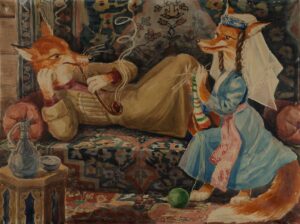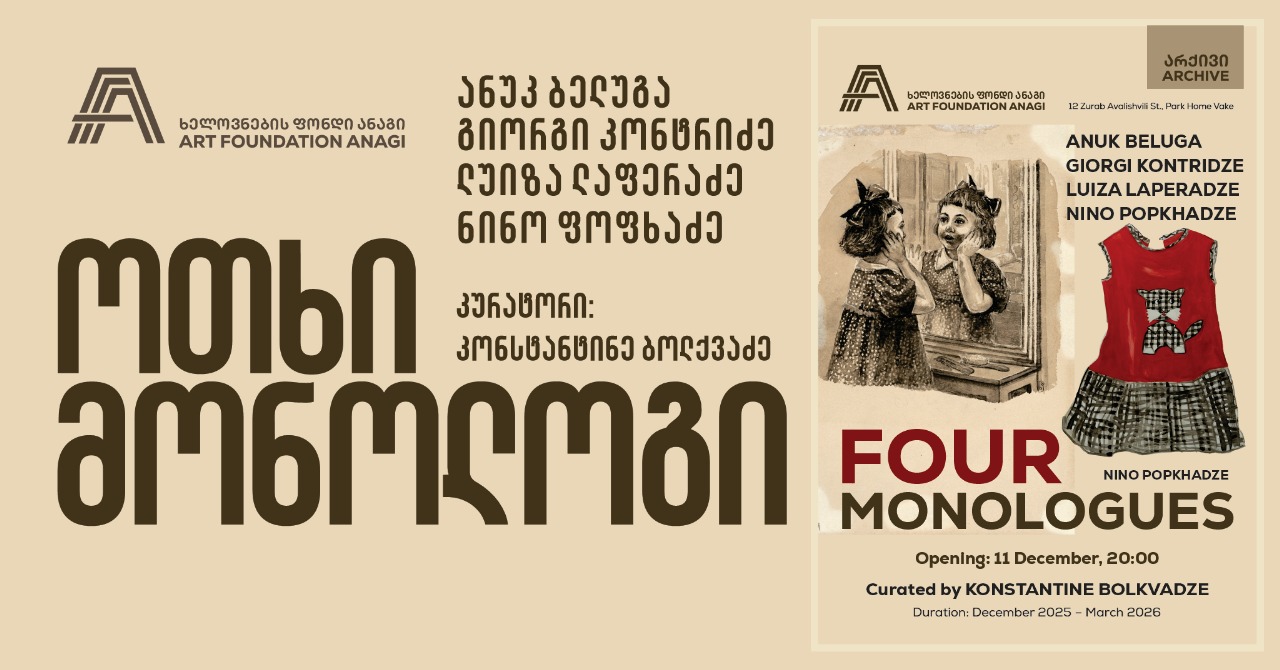
Some images outlive childhood: a drowsy, fluffy cat on a windowsill, a winter fairytale forest glazed with light on snow. They remain with us long after we forget where we first encountered them. A new exhibition in Tbilisi returns viewers to that intimate corner of memory.
“Nino Popkhadze – Four Monologues,” now on view at the Art Foundation Anagi, brings the overlooked children’s book illustrator Nino Popkhadze (1916–2001) back into public view, placing her work in dialogue with contemporary artists Anuk Beluga, Giorgi Kontridze, and Luiza Laperadze.
Her refined yet tender images feel remarkably present. What was once encountered at a child’s eye level now acquires a different clarity. In conversation with curator Konstantine Bolkvadze, the exhibition reflects on rediscovery and on the precarious fate of artists whose legacies depend on fragile archives, as well as on the willingness of institutions to bring them back into view.
Why did you decide to present Nino Popkhadze’s work after so many decades?
We encountered Popkhadze during archival research. Few works have survived, but what remains is extraordinary. Her visual language is canonical and highly refined, almost mathematical in its structure, yet remarkably contemporary.
We hope her work will be rediscovered by a younger generation and re-encountered by those who may remember her illustrations from childhood books.
In terms of genre and stylistic choice, her work exceeds the conventional understanding of Soviet art. She was a deeply versatile and multifaceted artist. It became clear that her absence from the narrative was not a matter of quality, but of circumstance.
Why did you choose to place her in dialogue with contemporary artists?
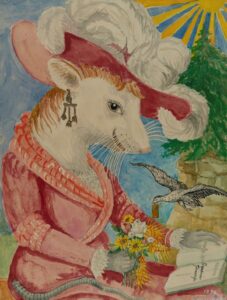
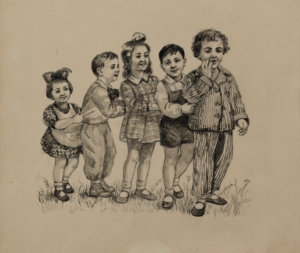
Her illustrations are playful and multilayered, created at a time when book design enjoyed a relative degree of freedom from the ideological control that shaped much of Soviet art. This space allowed her visual language to remain expressive, personal, and unexpectedly modern.
Presenting her work on its own would have risked confining it to the archive. I wanted instead to connect it with contemporary artists and reveal a shared cultural and aesthetic fabric.
I research and teach Soviet-era Georgian art, and my curatorial work is, in a way, a visual translation of that knowledge. What interests me is continuity: how certain visual and psychological coordinates persist across time. Contemporary artists often engage with similar objects, similar spatial relationships, and the same quiet phenomenology.
In this exhibition, the parallels are clear: cat to cat, still life to still life. Different decades, yet the same stillness and calibrated gaze. There is something distinct here compared with Western art: less polish, more austerity. A directness characteristic of Eastern Europe and the post-Soviet space.
The works by Anuk Beluga, Giorgi Kontridze, and Luiza Laperadze integrate naturally into Popkhadze’s iconography. Together they form a continuous thread of memory. The question is not one of influence, but of shared perception: time, space, melancholy, and focus, all grounded in a common cultural memory.
What challenges did you encounter while working on her archive?
Archival culture in Georgia remains fragile. Even major artists often lack complete documentation, and systematic institutional archiving was never fully embedded in cultural policy.
In Popkhadze’s case, even basic biographical material was scarce. Family members could offer only fragments, while state archives yielded very little. Such gaps create a real risk of disappearance.
Through projects like this, we try to fill those blank spaces. Once an archive is activated, something remarkable often happens: acquaintances come forward, stories surface, and a narrative begins to take shape. Context leads to analysis, and analysis eventually to scholarship.
Why does her work resonate today?
Modern Georgian art, much of it produced during the Soviet period, shaped the visual memory of nearly the entire twentieth century. For many, those images are inseparable from childhood and from the decades lived between the 1930s and the 1990s.
This is, in many ways, a generational story. Yet it also concerns younger viewers, who may feel no direct connection to that past. Many images that appear contemporary today are, in fact, sediments of that earlier visual culture.
Popkhadze worked primarily in book and easel graphics and watercolor. She illustrated numerous titles, including Georgian Folk Tales, The Fate of Kartli by Nikoloz Baratashvili. She studied at the Tbilisi State Academy of Arts and became a member of the Artists’ Union of the Georgian SSR in 1948. She exhibited regularly from 1939 onward, including solo and thematic exhibitions well into the 1990s.
Her life, however, was marked by personal tragedy. She is believed to have lost her only child at a young age and spent her final years in relative solitude in Tbilisi’s Chughureti district. Her later works, in particular, seem to speak of quiet grief, and perhaps of an attempt to retreat from harsh reality into the fragile, luminous world of fairytales.