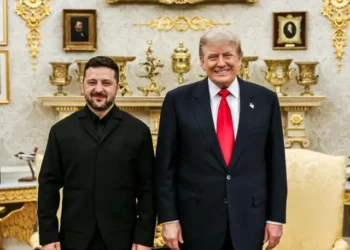
If something happens in Lithuania, we start fighting from the very first minute, – says Marek Kohv, Head of the Security & Resilience Program at Estonia’s International Center for Defense and Security, commenting on Tallinn’s latest Foreign Intelligence yearbook in an interview with RFE/RL’s Georgian Service.
The 2026 report warns that Russia is preparing for future confrontation even while bogged down in Ukraine, intensifying hybrid operations aimed at dividing European societies, and accelerating the development of unmanned warfare capabilities. While the report cautions that Russia is preparing for future conflict even as it fights in Ukraine, Kohv argues that a new large-scale offensive after 2029 is more likely than an imminent war, given Russia’s military and economic constraints. At the same time, he stresses that deterrence must begin immediately, as “the more we do to arm ourselves, the less likely the threat becomes.”
Before we even open Estonia’s Foreign Intelligence yearbook, another aspect catches the eye: the cover design. It appears to allude to the famous handshake between Presidents Putin and Trump. What is the message between the lines?
I think it illustrates the uncertainty we are facing right now, particularly the situation in which the US and Russia are trying to resolve the conflict between Ukraine and Russia. At the same time, it reflects the absence of European involvement. It is something we should pay attention to and ask ourselves what Europe’s role is in those negotiations.
Let’s turn to the report itself. What do you see as the main takeaways this year?
The report reaffirms much of what we already knew. For example, we are likely to see an increase in hybrid activities regardless of how successful or unsuccessful Russia is on the front line.
Russia does not view Estonia, Latvia, and Lithuania as separate states but as one operational area
These operations are relatively cheap and easy for Russia to carry out in Europe. Their main objective is to divide our societies and European countries so that support for Ukraine decreases and we begin infighting and blaming one another. This is something we will see more of this year and next.
Another key issue is Russia’s effort to integrate unmanned systems into future warfare. This must be taken very seriously by European states and NATO. Drone development is not something NATO has addressed seriously enough in recent years.
During a NATO exercise held in Estonia last year called Hedgehog, a Ukrainian drone unit of 10 men reportedly decimated two NATO battalions, leaving officials shaken. It is now 2026. Have these lessons been taken on board?
The exercise was designed specifically to demonstrate vulnerabilities. We invited the Ukrainians to showcase their experience and help us understand how to incorporate the drone threat into our training.
Some media outlets overstated how devastating the results were. Of course, we saw how effective drones can be in modern warfare. But the purpose was to draw lessons and adapt accordingly.
How large is the gap in unmanned warfare between Ukraine and Estonia? As a neighboring country, you are taking these lessons very seriously and face greater danger than most.
If anyone is closely studying and learning from Ukraine, it is Estonia. I do not think the knowledge gap is very large, because we are in daily contact with our Ukrainian counterparts and gather information directly from the front lines.
The real gap lies in industrial-scale production. That is a problem often overlooked. Modern battlefields serve as laboratories for rapid military innovation. Developments move so quickly that equipment that was effective one month may be obsolete the next. If you start mass-producing something today, it could already be outdated by the time it rolls off the production line.
What about Western European countries such as the UK, France, and Germany? Does the gap widen the further west you go?
The main issue beyond the Nordic regional coalition, including the Scandinavian countries, the Baltics, Poland, and to some extent the Netherlands and the UK, is not only the lack of interoperability among Europe’s many weapons systems, but also differences in threat perception.
In Western and Southern Europe, public awareness of the threat is quite different from what we experience here. This also affects drone development. There is a significant difference between living 20 to 50 kilometers from Russia and being separated by a thousand kilometers.
One key conclusion of the report is that Russia is highly likely preparing for future conflict even as it fights in Ukraine. The unanswered question is when.
Every intelligence service in Europe seems to agree that the timing of the next conflict will depend on how the war in Ukraine ends. Even if there is some kind of peace agreement, Russia’s ambitions will not disappear. Moscow will still aim to undermine Ukraine and change its regime. If that is the case, many Russian forces will remain in the region.
We must do everything within our power to deter Russia. The more we arm ourselves, the less likely the threat becomes
This leads me to assume that Russia does not have the capability to launch a new conflict elsewhere until it resolves the situation in Ukraine to its satisfaction. At the same time, we must remember that Russian logic does not always align with Western logic.
The situation in our region has also changed dramatically. Defense budgets have increased. Regional defense plans are in place. People often question whether Article 5 would work, but regional cooperation has become so strong that if something happened in the Baltic states, a coalition of the willing would begin fighting immediately.
There was a recent wargaming exercise reported by Die Welt in which Russia manufactured a humanitarian crisis to enter Lithuania, while NATO hesitated. If such a scenario unfolded, how would Estonia respond?
Estonia’s position is clear. We would start fighting from the very first minute, from the very first meter, if Russian forces appeared in Lithuania. Our experience from the Second World War has shaped this thinking. Russia does not view Estonia, Latvia, and Lithuania as separate states but as one operational area.
We cannot afford to assume it would stop with Lithuania. It would concern all of us, including Finland, Latvia, Lithuania, and Poland at the very least. Even before NATO’s Article 5 decision, mutual defense commitments would take effect. For Estonia, that primarily involves the UK and France, both nuclear powers. For Latvia, it is Canada; for Lithuania, Germany. By the time Article 5 is formally triggered, we would already be fighting.
Many Western analysts point to 2029 as a potential date for another Russian military adventure. Others argue it could happen sooner. Which camp are you in?
I am in the more cautious camp that believes any such move would likely occur after 2029. My main argument is the ongoing war in Ukraine. As long as it continues, Russia remains heavily engaged. In addition, sanctions are straining the Russian economy. Maintaining recruitment levels while paying more than a million soldiers is a heavy burden. Domestic dissatisfaction is also growing.
I do not see war as imminent. However, it would be dangerous to become complacent. We must do everything within our power to deter Russia. The more we arm ourselves, the less likely the threat becomes.
How quickly after a ceasefire could Moscow mount another offensive elsewhere?
That is ultimately a question for military planners. It would largely depend on logistics, specifically how quickly Russia could redeploy forces within its territory.
At the same time, there would be no element of surprise. Movements of troops and equipment toward our borders would be visible. We would respond accordingly by launching exercises, mobilizing troops, and moving equipment forward. It becomes a matter of parity.
Some sociologists argue that returning even part of the army to Russia could pose a domestic threat to Putin, tempting him to redirect it elsewhere, even if logistics are not ready. How convincing is that argument?
It is a strong argument. Putin often justifies Russia’s difficulties through the existence of war. Without it, explaining economic and social problems becomes harder. We have historical experience from the Soviet war in Afghanistan, which had serious domestic consequences when veterans returned.
Another factor is salaries. Soldiers fighting in Ukraine earn significantly more than the average Russian income. Returning home would mean facing much lower wages, which could create additional tensions.
If that logic is sound, why do you remain in the more cautious camp?
Because launching a poorly prepared offensive with inadequate logistics and insufficient equipment would likely end in conventional defeat. NATO and EU capabilities against lightly armored Russian infantry would create a devastating imbalance. However risky returning soldiers may be domestically, a failed external war could be even more destabilizing for the Kremlin.
Many analysts argue that if Russia strikes next, it will target the Baltics. But why the Baltics? Why not somewhere more vulnerable, such as Moldova or Georgia?
I understand the logic, but I would not describe Moldova as an easy target. Moldova has no land border with Russia. Any action there would depend heavily on Ukraine and Romania. That assumes the war in Ukraine ends without granting Russia land access to Moldova. If that changes, the situation would be entirely different. More broadly, if Putin seeks a symbolic victory, it might be easier to act in the Caucasus rather than risk a large-scale confrontation with NATO or the EU in the Baltics.
In the Caucasus, which countries appear more vulnerable?
In Georgia’s case, it is difficult to see how Russia could justify an invasion. Perhaps it doesn’t need justification. But if a government is already aligned with Moscow’s interests, there is little reason to invade militarily.
Armenia is a different matter. Like Moldova, Armenia does not share a land border with Russia, but Russia maintains a large military base in Gyumri. In contrast, the Russian troops stationed in Transnistria could not function as an effective invading force. Armenia presents a different strategic calculation.
What about Azerbaijan?
Azerbaijan is unlikely to be targeted. It has strong backing from Turkey, and their alliance is robust. Russia currently lacks the capacity to provoke Turkey in that way.
Interview by Vazha Tavberidze