Sophokles’ Antigone is undoubtedly one of the most famous works of Greek antiquity, known to anyone interested in theatre and literature. Staging it in contemporary times at the Berliner Ensemble theatre, with its remarkable history and spectacular ambience, requires profound knowledge, taste, and an emotional connection to the subject, because each new production is compared to previous ones in other theatres and other times. Luckily for all involved, director Johan Simons opted in this production for Hölderlin’s text of Antigone and for the “less is more” principle, reducing it all to a black-and-white colour palette and to three outstanding actors who impersonated the major protagonists, the chorus, and the rest of the important characters. Undoubtedly, Jens Harzer delivered one of the best performances of his career at the premiere, because his Antigone was so visceral, powerful, and over the top that it definitely set new standards for coming generations of performers. Rendering the complexity of it all with profound intensity, lightness, and passion would even make the blind see with their inner eye.
Antigone, of all people, had to be well aware of this as the daughter of Oedipus, who blinded himself when he learned the whole truth about killing his own father, King Laius of Thebes, and marrying his mother, Queen Iokasta; their children, born of this marriage, had to suffer the curse of the gods as a consequence of these sins. Constanze Becker and Kathleen Morgeneyer, playing Kreon, the new ruler of Thebes, and Ismene, Antigone’s sister, as well as the rest of the characters, were likewise as impressive and unforgettable. The act of cross-dressing, repeatedly recurring throughout the whole piece, gave it a seldom sense of fluidity of identities rather than genders, emphasizing the conventionalities of theatre. That it all irrevocably dealt with the realms of shadows and death was underlined, last but not least, by the ominous shades of the protagonists in reenactments of ancient Greek rituals with animal masks projected onto the white backgrounds behind them.
The familiar visual attributes of Greek antiquity—wreaths, walking canes, draped white garments, masks, and sacrificial ritual animal imitations—contributed to the authentic aura of ancient battlefields after the war’s end, sanctuaries, or burial places respectively, with a tongue-in-cheek hint at the theatrical artificiality of it all. The intensity of the tragic experience was heightened by Hölderlin’s text, which, despite its utter complexity, was rendered by the actors with rare beauty and ease. Hölderlin, a pivotal German Romantic poet and philosopher who spent a large part of his life in seclusion in a tower in Tübingen, could not fit better here as a metaphoric figure of the marginalized. Antigone’s shaking and shivering, as Jens Harzer portrayed her, will go into history as a symbolic gesture of awe culminating in despair, yet showing her unbreakable spirit, superior to bodily weakness. Trembling and shaking served as gestures imitating the quiverings of a soul touched by the monstrosities of this ancient story and of Antigone’s tragic fate.
In what way did Johan Simons’ interpretation of Antigone enrich the centuries-old tradition of the performing arts and our perception of her now? Probably it made evident that theatrical play and the theatre of wars and staged events fall together in a play of forms, creating revelatory new meanings; or that identities do not really exist but are preconditioned by costumes, contexts, historical circumstances, or private histories; that art is the highest and holiest sacrifice, recognizing neither earthly rulers nor their laws and belonging only to the upper eternal realms; and that old façades have to be torn down like scraps of paper to be reused as blindfolds to shut off the outer world in order to open up true inner visions, as the protagonists did on stage. Speaking of this, the remarkable stage designs by Johannes Schütz contributed significantly to the whole concept. It was all about touching the spectator’s soul, if such a thing ever exists, emotionally. As for meaning, it differs from epoch to epoch according to changing values, prevailing fashions, beliefs, cultures, and conventions.
Settings and interior designs play a significant part in our perception of things not only in the arts but in real life, especially when fine arts intervene in semi-private and public spaces like hotel suites, foyers, corridors, and spaces for eating and drinking. Berlin’s world-famous reputation as a metropolis for contemporary art has over decades attracted some of the most prominent blue-chip and award-winning artists who live and work here. Some of these, alongside superstars like Damien Hirst and Rosemarie Trockel, to name but a few, are beautifully fitted into the Château Royal Berlin boutique hotel in the heart of the city center.
Ninety-three international artists who have earned names and fame on international markets and museum scenes have been tastefully selected by Kirsten Landwehr, head of the art department, for the purpose of giving this hotel its extraordinary aura. The concept could not fit better, as it gives this historical edifice—formerly the quarters of the menacing ex-Stasi, the GDR Ministry of State Security—an “edgy” look. Art hotels are very trendy all over the world now, but Château Royal has managed to get in on a whole new level by combining its sumptuous interiors and luxurious furniture with provocative artworks that build contrasts and raise the curiosity of spectators. Needless to say, a couple of Georgian artists who made it into this honourable collection really hit it and truly added extra charm to the royal hotel ambience.
The contradiction between the opulent hotel context and the artistic interventions—some disruptive, others hardly noticeable, as if left over by chance, waiting to be discovered or forever overlooked—is exemplified by, for example, Thea Djordjadze’s inconspicuous installation in one of the hotel suites that draws upon mimicking interior design elements. Her lamp with the green lampshade next to the double bed, placed above the actual lamp, and its smaller image applied to the wooden wardrobe on the opposite side looks like a funny take on mimicry, the original and its copy. Thea Djordjadze, alongside Rosemarie Trockel, who used to be her teacher at the Düsseldorf Art Academy, both on view in this hotel, can hardly be overlooked and prove that artists’ collaborations evolve, as the two were already exhibited together at the Lenbachhaus and other Kunsthalles.
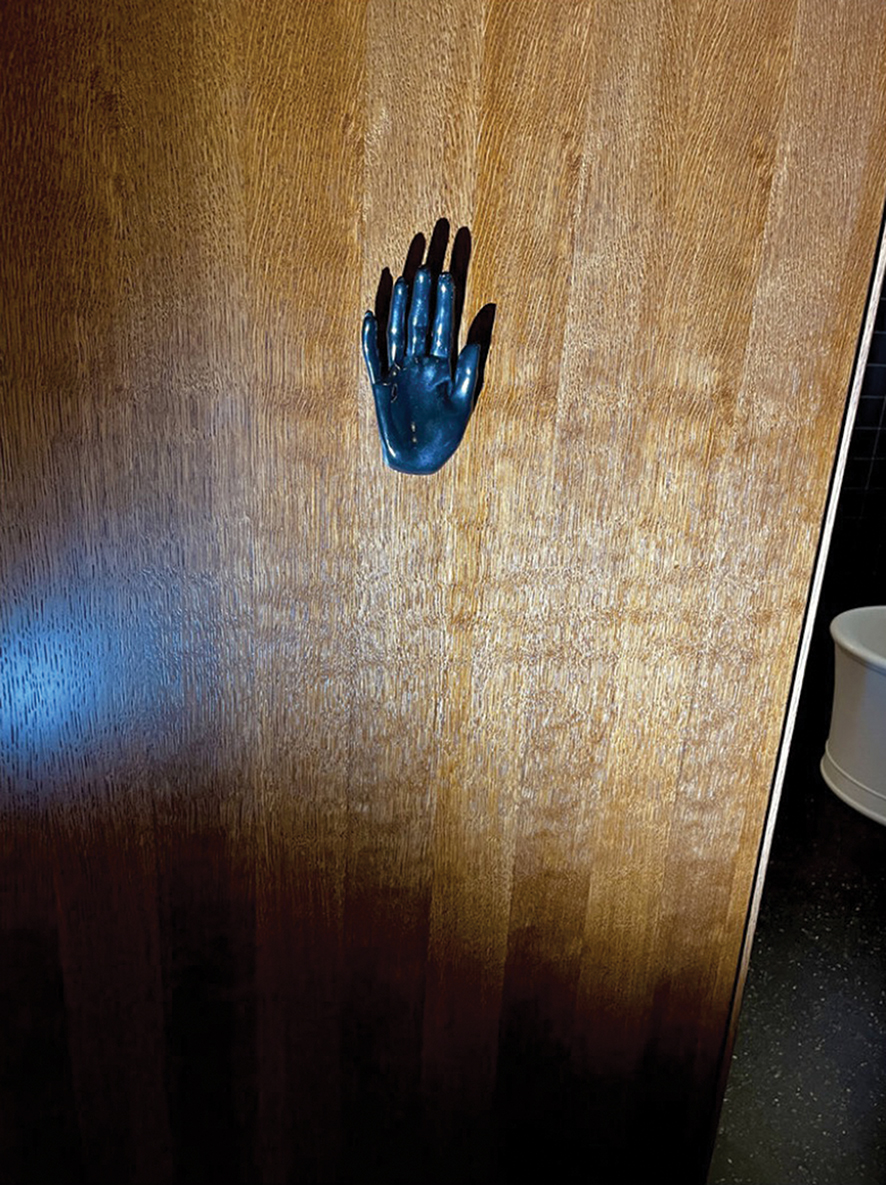
Ketuta Alexi-Meshishvili and Andro Wekua, on the contrary, opted for darker humor: a black hand against a wood-grain background casting an ominous shadow. A premonition, or maybe the hand of the hotel ghost waving to the shadows of past nightmares.
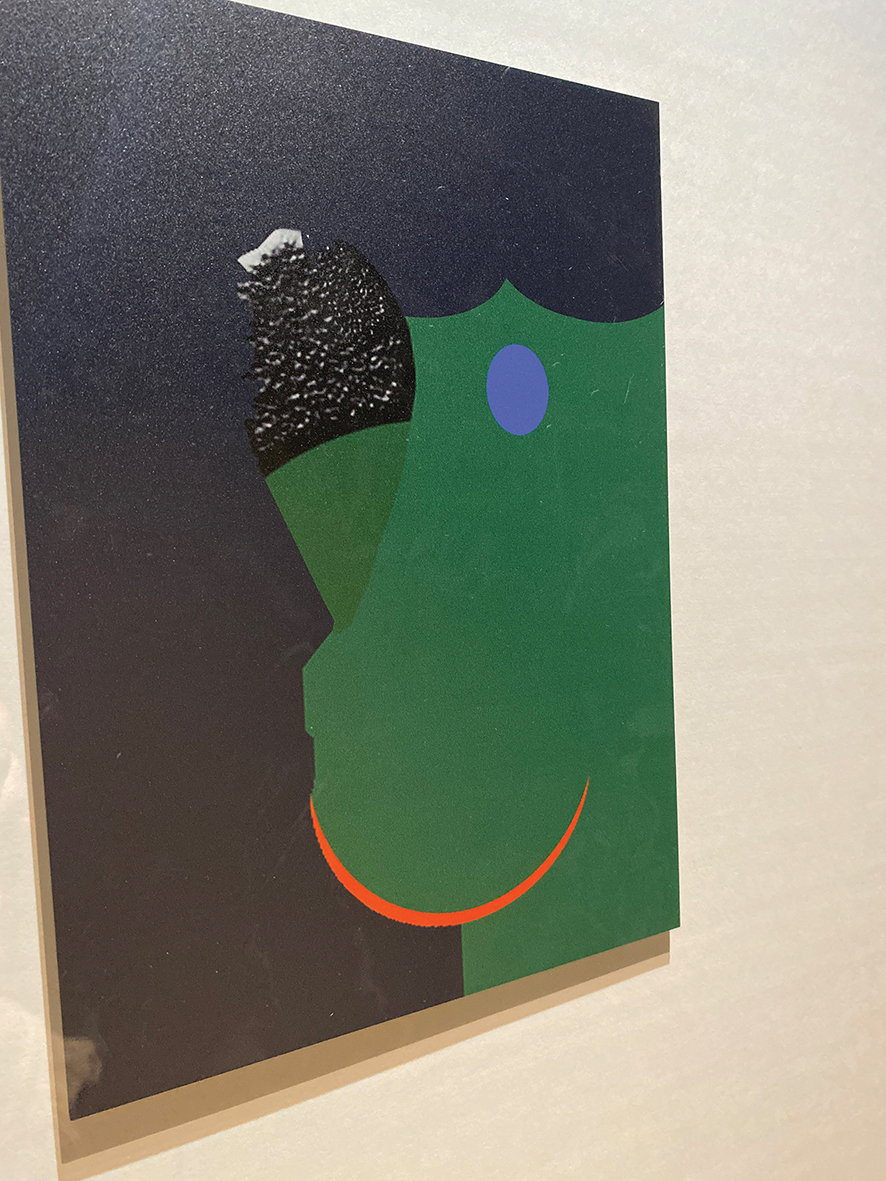
Salome Machaidze’s piece, spaciously displayed in the hallway in a wooden frame, appeared like a well-meaning dark figure in profile with a thin smile—maybe the artist’s self-portrait as I remember her, but probably it was just a silhouette of someone standing in a green meadow with a pool, looking for something. The green color corresponds beautifully with the hotel settings, as many parts, including the bathrooms, are decorated with specially produced green ceramic tiles that were used in the original building before the renovations.
All the artists’ names are indicated in white chalk writing above the suite entrances respectively, as if the suite numbers have been replaced by the names of the artists exhibited inside.
As for Shotiko Aptsiauri, the work still waits to be discovered, because that section of the hotel was in use by guests and staff. Semi-private spaces, like semi-public collections, are there for guests’ eyes only. Art in such places eliminates barriers between the private and the public by shifting conventional boundaries. This tour, opening up all the closed doors to show the collection, was an exception made for this review. Stay at Château Royal Berlin to discover more and indulge in contemporary art and lifestyle.
By Dr. Lily Fürstenow